IELTS, Writing Task 1
Diet types across three age groups, 2023: sample answer
A model answer to this exam-style IELTS writing task 1 question, written to a Band 8 target. See the question, the full answer and exactly why it works, then try it yourself.
- Task
- Writing Task 1
- Time
- 20 minutes
- Answer length
- 183 words
- Written to
- Band 8 target
The question
Task
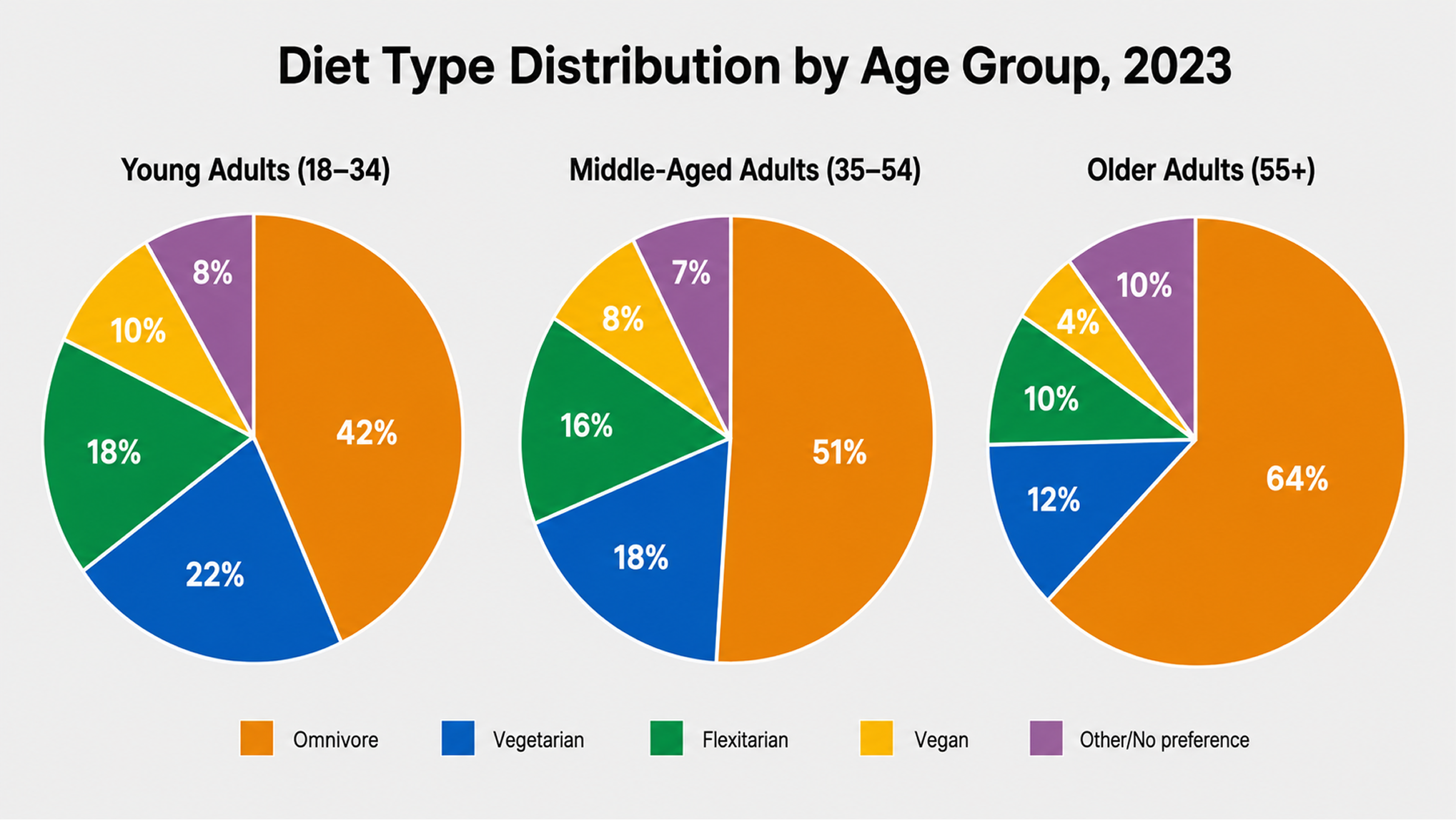
The three pie charts below show the proportion of people following different types of diets in three age groups, Young Adults (18–34), Middle-Aged Adults (35–54) and Older Adults (55+), in a survey conducted in 2023. Summarise the information by selecting and reporting the main features, and make comparisons where relevant. Write at least 150 words.
Sample answer
Linking words are highlighted: they show the structure a rater follows.
The three pie charts show the proportions of people in three age groups who followed different types of diet, according to a survey carried out in 2023.
Overall, omnivores formed the largest group in every age category, and their share increased with age. Conversely, all the plant-based diets became less common among older respondents.
Among young adults aged 18 to 34, omnivores made up 42% of the total, which means that the majority of this group followed other diets or had no preference. Vegetarians accounted for 22%, flexitarians for 18% and vegans for 10%, while 8% reported another diet or no preference.
The proportion of omnivores rose to just over half (51%) among middle-aged adults and reached almost two-thirds (64%) of those aged 55 and over. In contrast, the percentage of vegetarians fell from 18% in the middle-aged group to 12% among older adults, and flexitarians declined from 16% to 10%. Veganism also halved, from 8% to just 4%, making it the least popular choice among the oldest group, whereas the proportion with another or no preference was slightly higher there, at 10%.
183 words
Why it works
What you can measure in this answer, and what IELTS examiners mark.
- The right length. 183 words: inside the required 150–200, in 4 paragraphs.
- Clear links between ideas: “whereas”, “while”, “overall”, “in contrast”. They make the answer easy to follow, which raters reward under coherence.
- 4 paragraphs, each with its own job, so the reader can follow the answer at a glance.
How IELTS marks writing task 1
- Task AchievementBand 0–9
Answers every part of the task with relevant, well-supported ideas.
- Coherence & CohesionBand 0–9
Logical paragraphs and linking words that guide the reader.
- Lexical ResourceBand 0–9
A range of vocabulary used accurately and naturally.
- Grammatical Range & AccuracyBand 0–9
A mix of simple and complex sentences with few errors.
Common questions
How many words should a IELTS Writing Task 1 answer have?
The task asks for 150 to 200 words, written in 20 minutes. This sample is 183 words.
How is IELTS Writing Task 1 scored?
IELTS marks it on Task Achievement, Coherence & Cohesion, Lexical Resource, Grammatical Range & Accuracy, each on a Band 0 to 9 scale. Your result for the task comes from these together.
Is this a real IELTS question?
No. It's an original, exam-style question written to match the official format. Nobody can legally publish real test questions.
Should I memorise this answer?
No. Use it to see the structure, length and linking words that work, then answer in your own words. Memorised answers rarely fit a new question, and IELTS examiners notice relevant, natural answers.
Where can I practice this question and get a score?
Open it on a2zexams: record or type your own answer and get an instant estimated score on each IELTS criterion, with what to fix. It's free to start.
More Writing Task 1 sample answers
- How a university spends its budgetAllocation of a university's annual budget. Staff salaries 46%, Buildings and maintenance 17%, Research 14%, Student…
- Tourism spending in three regions, 2005 vs 2022The six pie charts below show the proportion of tourism spending allocated to different expenditure categories in three…
- Electricity generation by source, 2000–2025Electricity generated by source, 2000–2025. Coal: 2000 120TWh, 2005 115TWh, 2010 100TWh, 2015 75TWh, 2020 45TWh, 2025…
- Mobile contract costs at four companies, January–September 2002The chart below shows the average cost of a monthly contract for four different mobile (cell phone) companies in a…
- Men and women doing houseworkThe first chart below shows the percentages of women and men in a country involved in some kinds of home tasks…
- University library visits, purposes and time spentThe bar chart shows the number of library visits per month by user type at a university. The pie chart shows the…
Now try a writing task 1 question yourself
Write your answer and get an instant estimated IELTS band with what to fix. Free to start, nothing to install.