IELTS, Writing Task 1
Household energy sources in a European country, 2020: sample answer
A model answer to this exam-style IELTS writing task 1 question, written to a Band 8 target. See the question, the full answer and exactly why it works, then try it yourself.
- Task
- Writing Task 1
- Time
- 20 minutes
- Answer length
- 177 words
- Written to
- Band 8 target
The question
Task
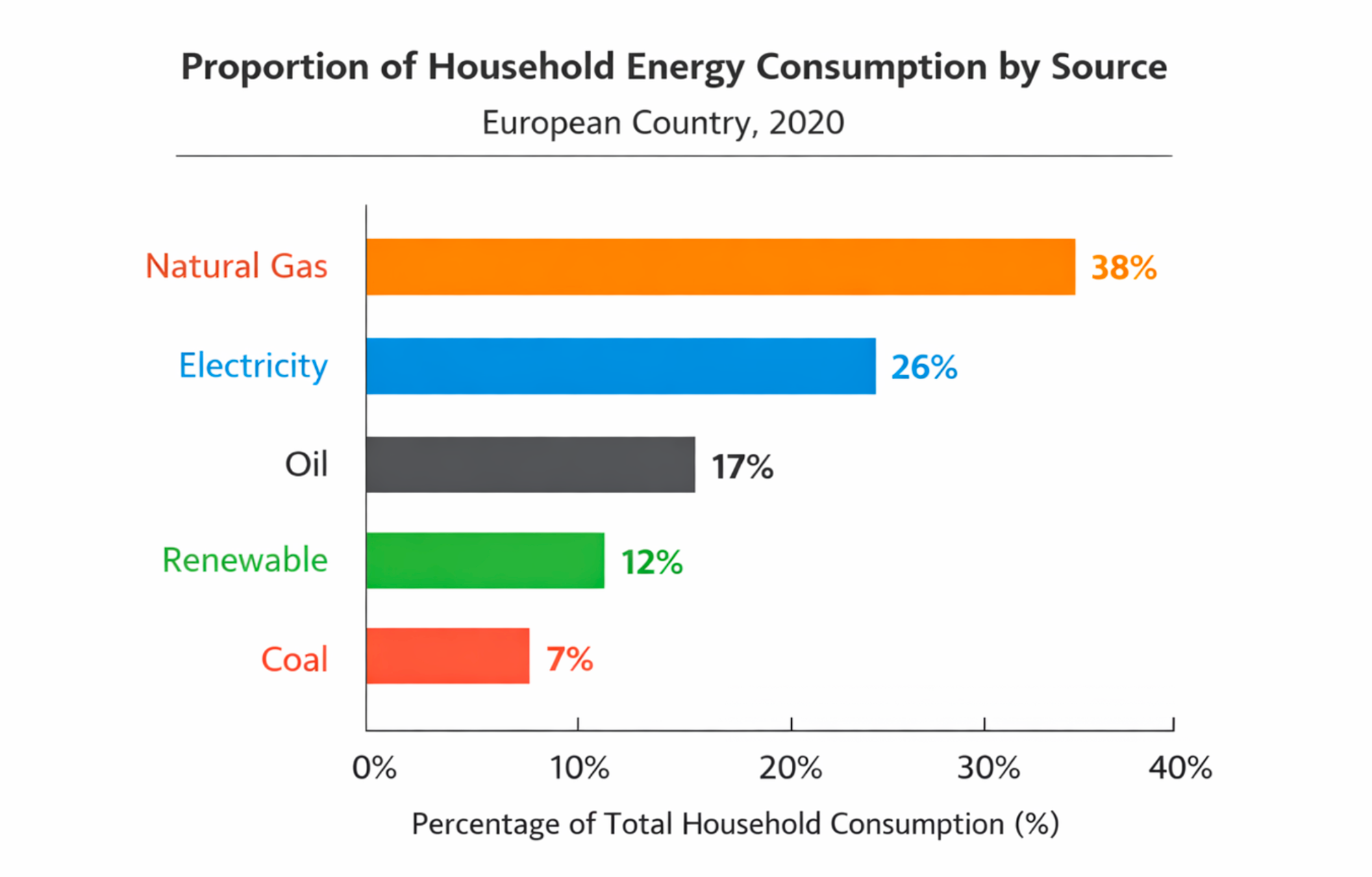
The bar chart below shows the proportion of household energy consumption by source in a European country in 2020. Summarise the information by selecting and reporting the main features, and make comparisons where relevant. Write at least 150 words.
Sample answer
Linking words are highlighted: they show the structure a rater follows.
The bar chart shows the share of household energy consumption accounted for by five different sources in a European country in 2020.
Overall, natural gas was by far the most important source of energy for households, while coal made the smallest contribution. Fossil fuels, taken together, supplied the majority of household energy, whereas renewable sources played a relatively minor role.
Natural gas made up 38% of total household consumption, the largest proportion by a considerable margin. Electricity was the second most significant source, at 26%, meaning that these two sources alone accounted for almost two-thirds (64%) of the energy used in homes.
The remaining three sources each contributed less than a fifth of the total. Oil represented 17% of household energy consumption, slightly less than half the share of natural gas. Renewable energy accounted for 12%, around a third of the figure for gas, and coal made up only 7%, the lowest proportion of all the sources shown. Combined, gas, oil and coal provided 62% of household energy, more than five times the share supplied by renewables.
177 words
Why it works
What you can measure in this answer, and what IELTS examiners mark.
- The right length. 177 words: inside the required 150–200, in 4 paragraphs.
- Clear links between ideas: “whereas”, “while”, “overall”. They make the answer easy to follow, which raters reward under coherence.
- 4 paragraphs, each with its own job, so the reader can follow the answer at a glance.
How IELTS marks writing task 1
- Task AchievementBand 0–9
Answers every part of the task with relevant, well-supported ideas.
- Coherence & CohesionBand 0–9
Logical paragraphs and linking words that guide the reader.
- Lexical ResourceBand 0–9
A range of vocabulary used accurately and naturally.
- Grammatical Range & AccuracyBand 0–9
A mix of simple and complex sentences with few errors.
Common questions
How many words should a IELTS Writing Task 1 answer have?
The task asks for 150 to 200 words, written in 20 minutes. This sample is 177 words.
How is IELTS Writing Task 1 scored?
IELTS marks it on Task Achievement, Coherence & Cohesion, Lexical Resource, Grammatical Range & Accuracy, each on a Band 0 to 9 scale. Your result for the task comes from these together.
Is this a real IELTS question?
No. It's an original, exam-style question written to match the official format. Nobody can legally publish real test questions.
Should I memorise this answer?
No. Use it to see the structure, length and linking words that work, then answer in your own words. Memorised answers rarely fit a new question, and IELTS examiners notice relevant, natural answers.
Where can I practice this question and get a score?
Open it on a2zexams: record or type your own answer and get an instant estimated score on each IELTS criterion, with what to fix. It's free to start.
More Writing Task 1 sample answers
- How a university spends its budgetAllocation of a university's annual budget. Staff salaries 46%, Buildings and maintenance 17%, Research 14%, Student…
- Tourism spending in three regions, 2005 vs 2022The six pie charts below show the proportion of tourism spending allocated to different expenditure categories in three…
- Electricity generation by source, 2000–2025Electricity generated by source, 2000–2025. Coal: 2000 120TWh, 2005 115TWh, 2010 100TWh, 2015 75TWh, 2020 45TWh, 2025…
- Mobile contract costs at four companies, January–September 2002The chart below shows the average cost of a monthly contract for four different mobile (cell phone) companies in a…
- Men and women doing houseworkThe first chart below shows the percentages of women and men in a country involved in some kinds of home tasks…
- University library visits, purposes and time spentThe bar chart shows the number of library visits per month by user type at a university. The pie chart shows the…
Now try a writing task 1 question yourself
Write your answer and get an instant estimated IELTS band with what to fix. Free to start, nothing to install.