IELTS Listening · Listening Part 3
Solar still design: diagram labelling
Plan, Map and Diagram Labelling practice, questions 21–26, with the transcript and every answer explained. Try the questions first; the answers are folded away below.
- Questions
- 21–26
- Transcript
- 493 words
- Level
- Harder
- Type
- Plan, Map and Diagram Labelling
The recording (transcript)
Listen first
Tutor: Right, Anna, Marcus, you wanted to talk me through the diagram for your solar still before you build the prototype. Go ahead.
Anna: Thanks. So the basic idea is very simple. Salt water sits in the box, the sun heats it, it evaporates, and the vapour condenses on the cover and runs down into a bottle as fresh water.
Tutor: And the cover is glass?
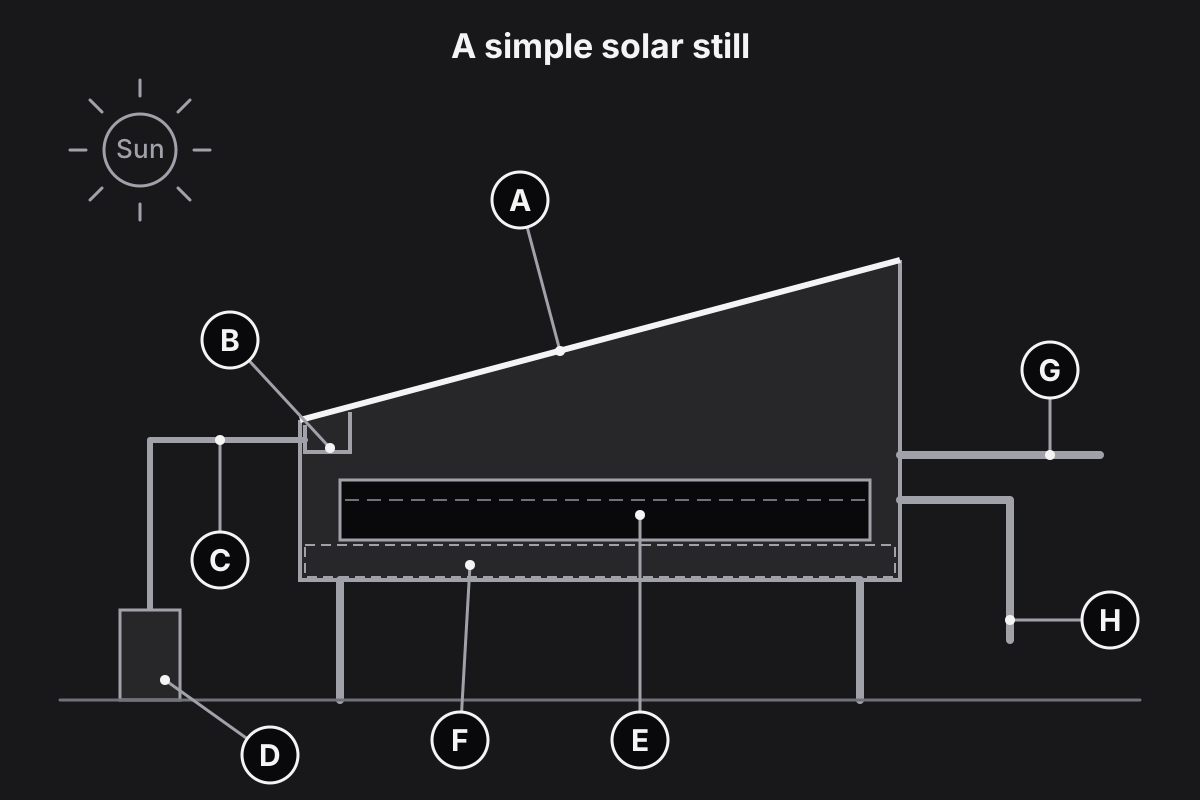
Marcus: Yes, it's the long sloping sheet across the top. We thought about plastic, because it's lighter, but glass lets more sunlight through and it doesn't scratch, so we went for that. It's tilted so that the high side faces away from the sun, and the droplets run down towards the low side.
Tutor: Fine. What about the bottom of the box?
Anna: Inside the box there's a shallow metal tray that holds the salt water. We've painted it black so that it absorbs as much heat as possible. That's the dark rectangle in the middle of the diagram.
Tutor: And underneath the tray?
Anna: There's a layer of foam between the tray and the floor of the box. It's the strip shown with a dotted outline right along the bottom. Without it, a lot of the heat would just be lost through the base.
Tutor: Good. Now, how do you actually collect the water?
Marcus: That's the clever part, we think. Along the bottom edge of the glass, on the inside, there's a little gutter. When the drops slide down the glass, they fall into it instead of dripping back into the tray. It's at the far left, at the lowest corner of the cover.
Tutor: And from the gutter it goes into this tube?
Marcus: Yes, the tube leads out through the left wall and down into the collecting bottle on the ground. We haven't decided what size the bottle will be yet.
Tutor: OK. And how does the salt water get in?
Anna: Through the pipe on the right-hand side, the tall side of the box. It comes in just above the level of the tray, so it pours in from the top. We had it at the bottom originally, but then the incoming cold water disturbed the warm water in the tray, so we moved it up.
Tutor: And there's another pipe below it, on the same side.
Anna: That's the overflow. It's level with the water in the tray, and it bends down towards the ground. If we pour in too much, the extra salt water runs out there, instead of flooding the gutter and spoiling the fresh water.
Tutor: Sensible. My only concern is the legs. Are they strong enough to hold the weight of the glass?
Marcus: We've used thick timber, so we think so, but we'll test that first.
Tutor: Good. And have you thought about how you'll clean the tray? Salt will build up quite quickly, you know.
Anna: Ah, not yet. We'll add that to the list.
Questions 21–26
Label the diagram below. Choose the correct letter, A–H, for each part.
- AA
- BB
- CC
- DD
- EE
- FF
- GG
- HH
- 21Glass cover
- 22Blackened tray
- 23Insulating foam
- 24Gutter
- 25Salt-water inlet
- 26Overflow pipe
Answers and explanations
Open one at a time to check as you go, or the key to mark them all.
Answer key: Questions 21–26Show
- 21A
- 22E
- 23F
- 24B
- 25G
- 26H
21Glass coverAnswer
Answer: A
“it's the long sloping sheet across the top” = A. Plastic was considered and rejected, but it's the same part either way.
22Blackened trayAnswer
Answer: E
“a shallow metal tray that holds the salt water … painted it black … the dark rectangle in the middle” = E.
23Insulating foamAnswer
Answer: F
“a layer of foam between the tray and the floor of the box … the strip shown with a dotted outline right along the bottom” = F.
24GutterAnswer
Answer: B
“Along the bottom edge of the glass, on the inside, there's a little gutter … at the far left, at the lowest corner of the cover” = B. C is the tube that leads from it.
25Salt-water inletAnswer
Answer: G
“the pipe on the right-hand side … It comes in just above the level of the tray” = G. The trap: it was at the bottom originally, but they moved it up.
26Overflow pipeAnswer
Answer: H
“another pipe below it, on the same side … level with the water in the tray, and it bends down towards the ground” = H.
More Plan, Map and Diagram Labelling practice
Common questions
Are these real IELTS Listening questions?
No. They're original practice questions written in the official IELTS format and numbering, with answers and explanations. Real test questions aren't published.
How should I use the answers?
Answer every question first, then check. For each one you got wrong, read the explanation and find the line in the transcript that gives the answer: that's where the trap or paraphrase is.
Can I hear the recording?
Yes: practice this question in the a2zexams app, where the recording plays (and later parts start where their questions are). This page shows the transcript so you can check every answer.
Hear it and answer in the app
See right and wrong at once with the reason for each, with the recording playing from where your questions start. Free to start, nothing to install.