IELTS Reading · Reading Passage 1
Atlantic salmon life cycle: label the diagram
Diagram Label Completion practice, questions 1–6, with the full passage and every answer explained. Try the questions first; the answers are folded away below.
- Questions
- 1–6
- Passage
- 684 words
- Level
- Easier
- Part
- 1 of 2 on this passage
The Long Journey of the Atlantic Salmon
AFew animals undertake a life as varied as that of the Atlantic salmon. Born in cold, fast-flowing rivers on both sides of the North Atlantic, it spends its youth in fresh water, travels thousands of kilometres to feeding grounds in the ocean and then, with remarkable accuracy, returns to the stream where it hatched in order to breed. Each stage of this cycle has its own name, its own appearance and its own dangers, and the species' decline over the past half-century can only be understood by looking at all of them. In many rivers, the number of adults returning each year is now a small fraction of what it was in the 1970s, and researchers are still trying to establish where in the cycle the heaviest losses occur.
BThe cycle begins in late autumn, when a female selects a stretch of clean gravel where water flows steadily through the riverbed. Turning on her side and beating her tail, she digs a shallow depression known as a redd. She lays her eggs in it, a male fertilises them, and she then covers them with gravel by digging another hollow just upstream. A large female may produce several thousand eggs in this way. The flow of water through the gravel is essential, because it carries oxygen to the developing embryos and removes their waste; if fine silt from farmland or construction clogs the spaces between the stones, the eggs suffocate.
CThe eggs hatch in early spring, but the young fish, called alevins, do not leave the gravel at once. Each carries a yolk sac attached to its belly, a store of food that sustains it for several weeks while it remains hidden among the stones. Only when the yolk has been absorbed does the young salmon wriggle up into open water and begin to feed on tiny insects. At this point it is known as a fry, and the losses are enormous: most fry are eaten by birds, other fish or even older salmon within their first summer.
DSurvivors grow into parr, which can be recognised by a row of dark, thumbprint-shaped blotches along their sides. These parr marks act as camouflage against the pebbly riverbed. Parr are fiercely territorial, each defending its own patch of stream, and they remain in fresh water for anything from one to four years, depending largely on temperature and the supply of food: in the warmer rivers of the south, they grow faster and leave sooner than in the north.
EWhen a parr reaches a length of around twelve to fifteen centimetres, it undergoes a striking transformation. Its body becomes slimmer, the parr marks disappear under a coat of silvery scales, and its kidneys and gills change so that it can cope with salt water. The fish, now called a smolt, gathers with others and drifts downstream in spring, entering the sea mainly at night, when it is harder for predators to see. Even so, many smolts are lost in estuaries, where seals, birds and larger fish gather to feed on them.
FAt sea, the salmon feeds on small fish and crustaceans and grows rapidly. Some return to their river after a single winter in the ocean; these fish, known as grilse, are relatively small. Others stay two or three winters and come back much heavier. How they find the right river after such a journey is still debated, but experiments suggest that they navigate the open ocean partly using the Earth's magnetic field and then identify their home river by its distinctive smell.
GHaving returned, the adults stop feeding altogether and live on their reserves of fat while they move upstream to the spawning grounds, leaping weirs and waterfalls on the way. Spawning exhausts them, and most die soon afterwards. Unlike the Pacific species, however, a proportion of Atlantic salmon survive; these thin, weakened fish, called kelts, drift back to the sea and may return to spawn a second or even a third time. Fisheries scientists value them highly, because large, repeat-spawning females contribute a disproportionate share of each river's eggs.
Questions 1–6
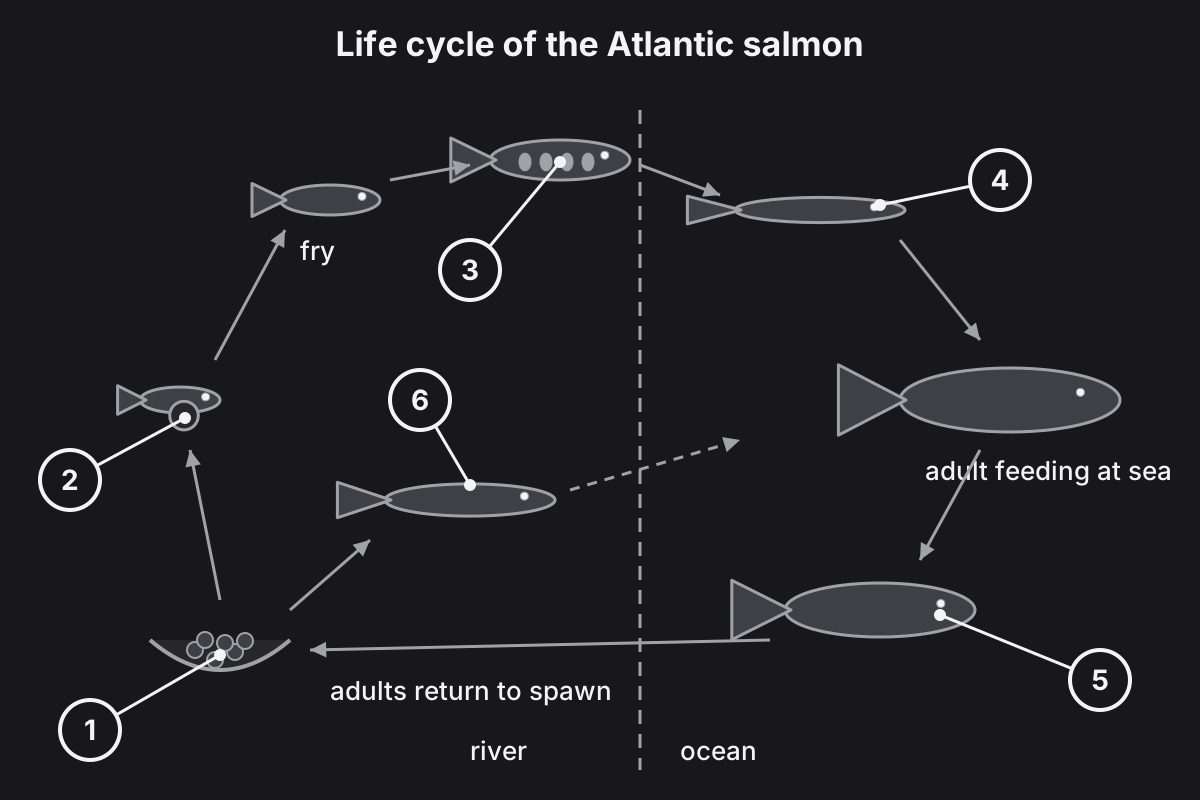
Label the diagram below. Choose NO MORE THAN TWO WORDS from the passage for each answer.
NO MORE THAN TWO WORDS
1 eggs laid in a gravel nest called a (1) ________ 2 alevin living on its (2) ________ 3 parr camouflaged by dark (3) ________ 4 silvery (4) ________ heading downstream to the sea 5 (5) ________ returning after one winter at sea 6 surviving adults, or (6) ________, drifting back to sea
Answers and explanations
Open one at a time to check as you go, or the key to mark them all.
Answer key: Questions 1–6Show
- 1redd
- 2yolk sac
- 3parr marks
- 4smolt
- 5grilse
- 6kelts
11 eggs laid in a gravel nest called a ________Answer
Answer: redd
Paragraph B: 'she digs a shallow depression known as a redd'. 'Gravel' is printed in the label.
22 alevin living on its ________Answer
Answer: yolk sac
Paragraph C: 'Each carries a yolk sac attached to its belly, a store of food'. Write the part, not 'store of food' (three words).
33 parr camouflaged by dark ________Answer
Answer: parr marks (also accepted: marks, blotches)
Paragraph D: 'These parr marks act as camouflage'. 'Blotches' is accepted, but 'parr marks' is the passage's name for them.
44 silvery ________Answer
Answer: smolt (also accepted: smolts)
Paragraph E: 'The fish, now called a smolt, ... drifts downstream in spring'.
55 ________Answer
Answer: grilse
Paragraph F: fish that 'return ... after a single winter in the ocean ... known as grilse'. Fish staying two or three winters have no special name.
66 surviving adults, or ________Answer
Answer: kelts (also accepted: kelt)
Paragraph G: 'these thin, weakened fish, called kelts, drift back to the sea'.
The rest of this passage
Other question types on the same text, like the paper.
More Diagram Label Completion practice
Common questions
Are these real IELTS Reading questions?
No. They're original practice questions written in the official IELTS format and numbering, with answers and explanations. Real test questions aren't published.
How should I use the answers?
Answer every question first, then check. For each one you got wrong, read the explanation and find the line in the passage that gives the answer: that's where the trap or paraphrase is.
Does spelling count?
Yes. In IELTS Reading a misspelt word is marked wrong, and so is an answer over the word limit in the instructions. British and American spellings are both accepted.
Answer it in the app
See right and wrong at once with the reason for each. Free to start, nothing to install.