IELTS Reading · Reading Passage 1
Pendulum clocks: label the diagram
Diagram Label Completion practice, questions 7–12, with the full passage and every answer explained. Try the questions first; the answers are folded away below.
- Questions
- 7–12
- Passage
- 702 words
- Level
- Easier
- Part
- 2 of 2 on this passage
The Pendulum and the Measurement of Time
ABefore the middle of the seventeenth century, even the finest mechanical clocks were poor timekeepers. Most relied on a device called the verge and foliot, a swinging bar whose speed depended heavily on the force driving it and on the friction in the mechanism. A good example might gain or lose a quarter of an hour in a single day, which is why many public clocks of the period had an hour hand but no minute hand: there was little point in displaying a precision the machine could not deliver.
BThe change came from a simple observation. A pendulum of a given length takes almost the same time to complete each swing, whether it is swinging widely or only a little. Galileo Galilei had noticed this property and, late in his life, sketched a design for a pendulum-controlled clock, but it was the Dutch scientist Christiaan Huygens who built the first working example in 1656. His clocks were accurate to within about a quarter of a minute a day, an improvement of roughly sixty times, and within a few years clockmakers across Europe were converting older clocks to the new system.
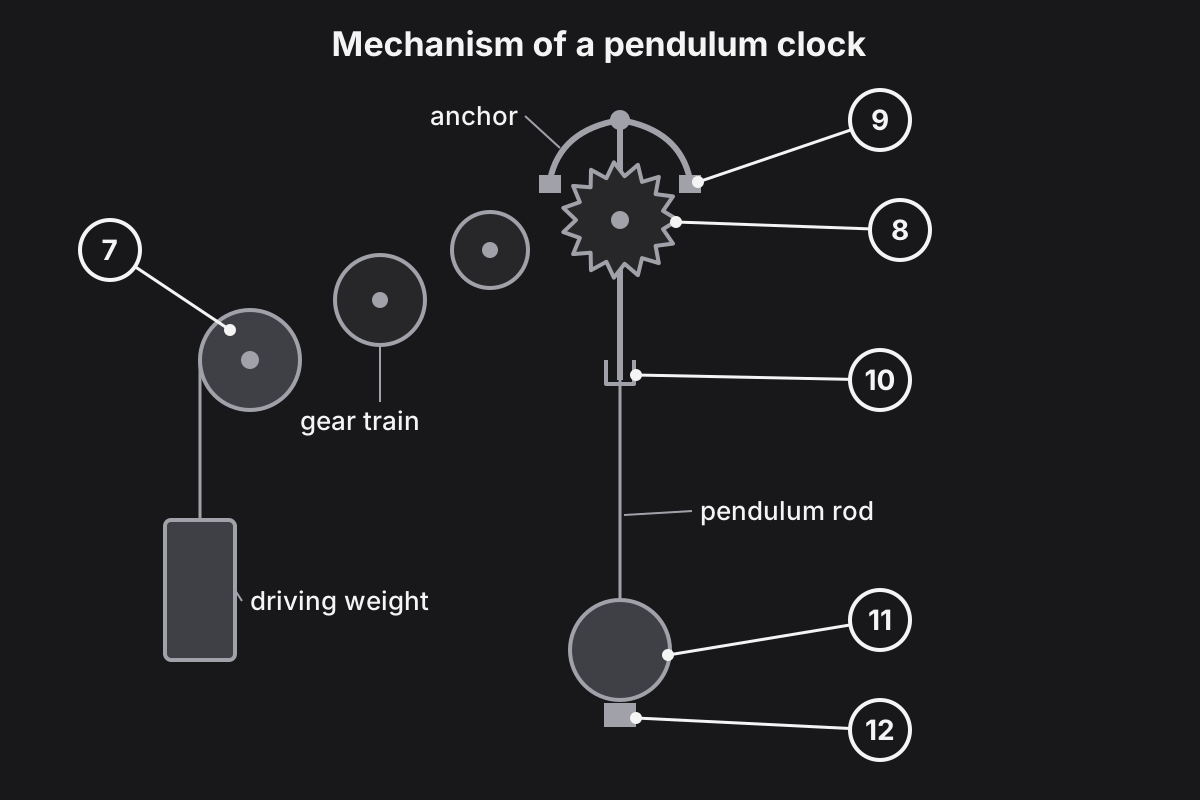
CIn the classic longcase clock, which developed from this work, the energy comes from a driving weight hanging on a cord. The cord is wound around a wooden or brass barrel, and as the weight slowly descends, it turns the barrel. This in turn drives a gear train, a series of toothed wheels that transmit the motion at carefully chosen ratios so that the hands move at the correct rate. Left to itself, however, the weight would simply fall to the bottom of the case in a few seconds, spinning the wheels uselessly. Something has to release the energy in small, regular portions.
DThat is the task of the escapement. At the top of the gear train sits the escape wheel, which has sharp, sloping teeth. Above it rocks the anchor, named for its resemblance to a ship's anchor, whose two curved arms end in hardened surfaces called pallets. As the anchor tilts one way, one pallet catches a tooth of the escape wheel and holds it; as it tilts back, the tooth is released and the wheel advances a short distance before the other pallet catches it. Each release produces the familiar tick, and each time a tooth slides off a pallet, it gives the anchor a tiny push.
EThe anchor is connected to the pendulum by a light vertical arm called the crutch, whose forked lower end loosely holds the pendulum rod. Through the crutch, the pendulum dictates the rhythm at which the anchor rocks, while the small push from the escape wheel keeps the pendulum swinging against the slowing effects of air resistance and friction. At the bottom of the rod hangs the bob, a heavy disc usually made of brass-faced lead. In a typical longcase clock, the pendulum is just under a metre long and takes exactly one second to make each swing.
FFine adjustment is made with the rating nut, a small threaded nut directly beneath the bob. Turning it raises or lowers the bob slightly: raising it shortens the pendulum, so that it swings faster and the clock gains time, while lowering it has the opposite effect. Owners of such clocks soon learned, however, that no setting stayed correct all year. In warm weather a metal rod expands, the pendulum lengthens and the clock runs slow; in winter it contracts and the clock runs fast.
GSolving this problem occupied some of the best minds of the eighteenth century. George Graham replaced the solid bob with a jar of mercury, which expands upwards as the rod expands downwards, so that the two effects cancel out. John Harrison, better known for his marine timekeepers, devised the gridiron pendulum, in which rods of brass and steel, metals that expand at different rates, were arranged so that their changes in length offset each other. With such refinements, the best regulator clocks of the period kept time to within a second or so a week, and pendulum clocks remained the standard in astronomical observatories until quartz clocks replaced them in the twentieth century.
Questions 7–12
Label the diagram below. Choose NO MORE THAN TWO WORDS from the passage for each answer.
NO MORE THAN TWO WORDS
7 (7) ________ that the cord is wound around 8 (8) ________ with sharp, sloping teeth 9 hardened (9) ________ at the ends of the anchor 10 (10) ________ with a forked lower end 11 heavy (11) ________ of brass-faced lead 12 (12) ________ used for fine adjustment
Answers and explanations
Open one at a time to check as you go, or the key to mark them all.
Answer key: Questions 7–12Show
- 7barrel
- 8escape wheel
- 9pallets
- 10crutch
- 11bob
- 12rating nut
77 ________Answer
Answer: barrel (also accepted: the barrel)
Paragraph C: 'The cord is wound around a wooden or brass barrel'. 'Cord' is already in the label.
88 ________Answer
Answer: escape wheel
Paragraph D: 'the escape wheel, which has sharp, sloping teeth'. The 'gear train' is the set of wheels below it, already labelled.
99 hardened ________Answer
Answer: pallets
Paragraph D: the anchor's arms 'end in hardened surfaces called pallets'. 'Anchor' is printed on the diagram.
1010 ________Answer
Answer: crutch (also accepted: the crutch)
Paragraph E: 'a light vertical arm called the crutch, whose forked lower end loosely holds the pendulum rod'. Do not write 'pendulum rod': that is printed.
1111 heavy ________Answer
Answer: bob (also accepted: the bob)
Paragraph E: 'the bob, a heavy disc usually made of brass-faced lead'. 'Disc' describes its shape; 'bob' is its name.
1212 ________Answer
Answer: rating nut
Paragraph F: 'Fine adjustment is made with the rating nut'.
The rest of this passage
Other question types on the same text, like the paper.
More Diagram Label Completion practice
Common questions
Are these real IELTS Reading questions?
No. They're original practice questions written in the official IELTS format and numbering, with answers and explanations. Real test questions aren't published.
How should I use the answers?
Answer every question first, then check. For each one you got wrong, read the explanation and find the line in the passage that gives the answer: that's where the trap or paraphrase is.
Does spelling count?
Yes. In IELTS Reading a misspelt word is marked wrong, and so is an answer over the word limit in the instructions. British and American spellings are both accepted.
Answer it in the app
See right and wrong at once with the reason for each. Free to start, nothing to install.