IELTS Reading · Reading Passage 1
Dragonfly life cycle: label the diagram
Diagram Label Completion practice, questions 1–6, with the full passage and every answer explained. Try the questions first; the answers are folded away below.
- Questions
- 1–6
- Passage
- 677 words
- Level
- Easier
- Part
- 1 of 2 on this passage
The Double Life of the Dragonfly
ADragonflies are among the most accomplished fliers in the insect world. They can hover, fly backwards and reach speeds of over thirty kilometres an hour, and they catch most of their prey, such as midges and mosquitoes, in mid-air. Yet the brightly coloured adults that patrol ponds and rivers in summer represent only a short final chapter in the insect's life. For most species, by far the greater part of life is spent underwater, as a predator that few people ever see.
BThe cycle begins when a female lays her eggs, either directly into the water or, in many species, into the stems of plants growing at the water's edge, which she slits open with a blade-like egg-laying tube at the tip of her abdomen. Depending on the species and the temperature, the eggs hatch after anything from a week to several months. What emerges is not a miniature dragonfly but a wingless aquatic creature called a nymph, sometimes also known as a larva.
CThe nymph is a formidable hunter. Its most remarkable feature is the mask, a hinged lower lip that is normally folded beneath the head. When prey comes within range, the mask shoots forward in a fraction of a second, seizing the victim with two hooks at its tip and drawing it back to the jaws. Small nymphs feed on water fleas and mosquito larvae, while the largest can catch tadpoles and even small fish. Most species hunt by waiting motionless among weeds or in the mud, relying on camouflage rather than speed.
DBreathing underwater is achieved in an unusual way. In the larger dragonflies, the gills are not on the outside of the body but inside the rectum, at the rear end of the abdomen. The nymph pumps water in and out to extract oxygen, and by forcing water out suddenly it can also shoot forward in a kind of jet propulsion, a useful means of escape from predators. As the nymph grows, it sheds its tough outer skin several times, a process known as moulting; each stage between moults is called an instar, and a nymph may pass through ten or more before it is fully grown. Small, flat wing buds on its back become more prominent with each moult.
EThe nymph stage can last from a few months to five years or more, depending on the species and on how much food is available. When it is finally ready, usually on a warm night or early morning in late spring or summer, the nymph climbs out of the water up the stem of a reed or other plant. It grips the stem firmly with its legs and, over a period of several hours, undergoes the most dramatic change of its life. The skin splits along the back of the thorax, and the adult slowly pulls itself free.
FAt first the newly emerged adult is soft and pale, and its crumpled wings are useless. Fluid is pumped into the veins of the wings to expand them, and they then need time to dry and harden before the insect can fly. This is a period of great danger, since the dragonfly cannot escape birds or other predators. Left behind on the stem is the empty skin of the nymph, called an exuvia. Naturalists collect these delicate cases, because each one proves that a dragonfly has successfully completed its development at that site.
GThe adult may live for only a few weeks. Its huge compound eyes, made up of as many as 30,000 individual units, give it almost all-round vision, and its two pairs of wings can be moved independently, allowing extraordinary control in flight. Ecologist Dr Samuel Okafor, who has surveyed dragonflies at more than a hundred ponds, argues that they are excellent indicators of the health of freshwater habitats, because nymphs need clean, well-oxygenated water to survive for so long. Counts of exuviae, he suggests, give a more reliable picture of a pond's condition than sightings of adults, which may have flown in from elsewhere.
Questions 1–6
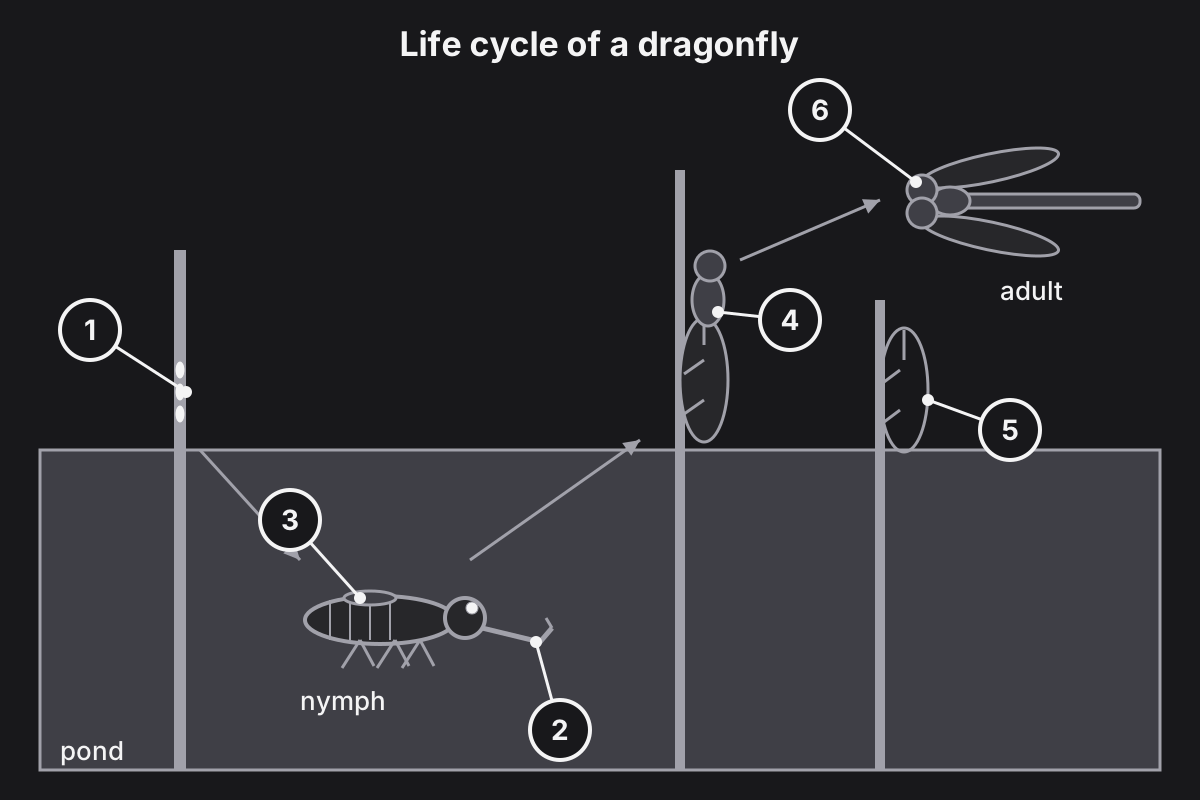
Label the diagram below. Choose NO MORE THAN TWO WORDS from the passage for each answer.
NO MORE THAN TWO WORDS
1 eggs laid inside plant (1) ________ 2 hinged lower lip, or (2) ________, catching prey 3 (3) ________ on the nymph's back 4 skin splitting along the (4) ________ 5 empty nymph skin, or (5) ________ 6 (6) ________ giving all-round vision
Answers and explanations
Open one at a time to check as you go, or the key to mark them all.
Answer key: Questions 1–6Show
- 1stems
- 2mask
- 3wing buds
- 4thorax
- 5exuvia
- 6compound eyes
11 eggs laid inside plant ________Answer
Answer: stems (also accepted: stem)
Paragraph B: eggs are laid 'into the stems of plants growing at the water's edge'. The 'egg-laying tube' belongs to the female, not the plant.
22 hinged lower lip, or ________Answer
Answer: mask (also accepted: the mask)
Paragraph C: 'the mask, a hinged lower lip that is normally folded beneath the head'.
33 ________Answer
Answer: wing buds
Paragraph D: 'Small, flat wing buds on its back become more prominent with each moult'. The gills are inside the body, so they cannot be seen.
44 skin splitting along the ________Answer
Answer: thorax (also accepted: back)
Paragraph E: 'The skin splits along the back of the thorax'. Either 'thorax' or 'back' fits, since both are in the phrase.
55 empty nymph skin, or ________Answer
Answer: exuvia
Paragraph F: 'the empty skin of the nymph, called an exuvia'. The plural 'exuviae' does not fit 'an' empty skin on one stem.
66 ________Answer
Answer: compound eyes
Paragraph G: 'Its huge compound eyes ... give it almost all-round vision'.
The rest of this passage
Other question types on the same text, like the paper.
More Diagram Label Completion practice
Common questions
Are these real IELTS Reading questions?
No. They're original practice questions written in the official IELTS format and numbering, with answers and explanations. Real test questions aren't published.
How should I use the answers?
Answer every question first, then check. For each one you got wrong, read the explanation and find the line in the passage that gives the answer: that's where the trap or paraphrase is.
Does spelling count?
Yes. In IELTS Reading a misspelt word is marked wrong, and so is an answer over the word limit in the instructions. British and American spellings are both accepted.
Answer it in the app
See right and wrong at once with the reason for each. Free to start, nothing to install.