IELTS Reading · Reading Passage 1
Gothic cathedrals: label the diagram
Diagram Label Completion practice, questions 7–11, with the full passage and every answer explained. Try the questions first; the answers are folded away below.
- Questions
- 7–11
- Passage
- 677 words
- Level
- Easier
- Part
- 2 of 2 on this passage
Building Upwards: The Gothic Cathedral
ABetween the middle of the twelfth century and the end of the fifteenth, the cities of western Europe raised a series of buildings that still astonish visitors: the great Gothic cathedrals. Compared with the churches that preceded them, they were taller, lighter and more open, with walls that seemed to dissolve into glass. The style first appeared around 1140 at the abbey church of Saint-Denis, just north of Paris, where Abbot Suger rebuilt the eastern end of the church to admit as much light as possible, and within a century it had spread from France to England, Germany, Spain and beyond.
BThe achievement is all the more remarkable because the builders had no theory of structures in the modern sense. Master masons learned their craft through long apprenticeships, guarding their methods closely and relying on geometric rules of proportion handed down from one generation to the next. Their designs were tested, in effect, by experiment, and not every experiment succeeded. At Beauvais, where the choir vault was raised to a height of about forty-eight metres, part of the vault collapsed in 1284, only twelve years after its completion.
CThe essential problem was one of forces. A stone vault is heavy, and its weight pushes not only downwards but also outwards, tending to force the supporting walls apart. The older Romanesque churches had resisted this thrust with massive walls and small windows. Gothic builders found a different solution, which began with the pointed arch. Because a pointed arch directs more of the load downwards than a semicircular one, it produces less outward thrust, and its height can be varied without changing its width, which gave designers great freedom in planning.
DAbove the main space of the church, the nave, the masons constructed ribbed vaults. In this system, a framework of stone ribs was built first on temporary wooden supports, and the thinner panels of stone between the ribs were filled in afterwards. The ribs gathered the weight of the ceiling and channelled it to a few specific points, rather than spreading it along the whole length of the wall. This meant that, between those points, the wall no longer had to carry much load at all, and it could be opened up with large windows.
EThe remaining outward thrust at the top of the walls was dealt with by the most striking feature of Gothic architecture: the flying buttress. This is a half-arch of stone that springs from a tall, solid pier standing outside the building and leans against the upper wall of the nave, exactly where the thrust of the vault is greatest. The buttress carries the force across the aisle below and down through the pier into the ground. On top of many piers sits a pinnacle, a pointed stone turret. Pinnacles were once thought to be purely decorative, but their weight presses down on the pier and helps to turn the sideways force more nearly downwards, making the pier more stable.
FThe result was a building in which the upper walls could be pierced almost entirely by windows. The highest level of the nave, known as the clerestory, became a band of stained glass through which coloured light poured into the interior. At Chartres, which keeps most of its original glass, more than 150 windows survive from the early thirteenth century. For medieval worshippers, this light had a spiritual meaning, and Suger himself wrote of light as a reflection of the divine.
GBuilding on this scale was slow and costly. Most cathedrals took several generations to complete, and many were never finished as planned; Cologne Cathedral, begun in 1248, was not completed until 1880. Historian Dr Marguerite Lasalle argues that we should see these buildings less as the work of individual geniuses than as the product of entire communities, whose donations, labour and patience sustained construction over centuries. Masons also left their personal marks on the stones they cut, small symbols that today allow researchers to trace individual craftsmen as they moved from one building site to another.
Questions 7–11
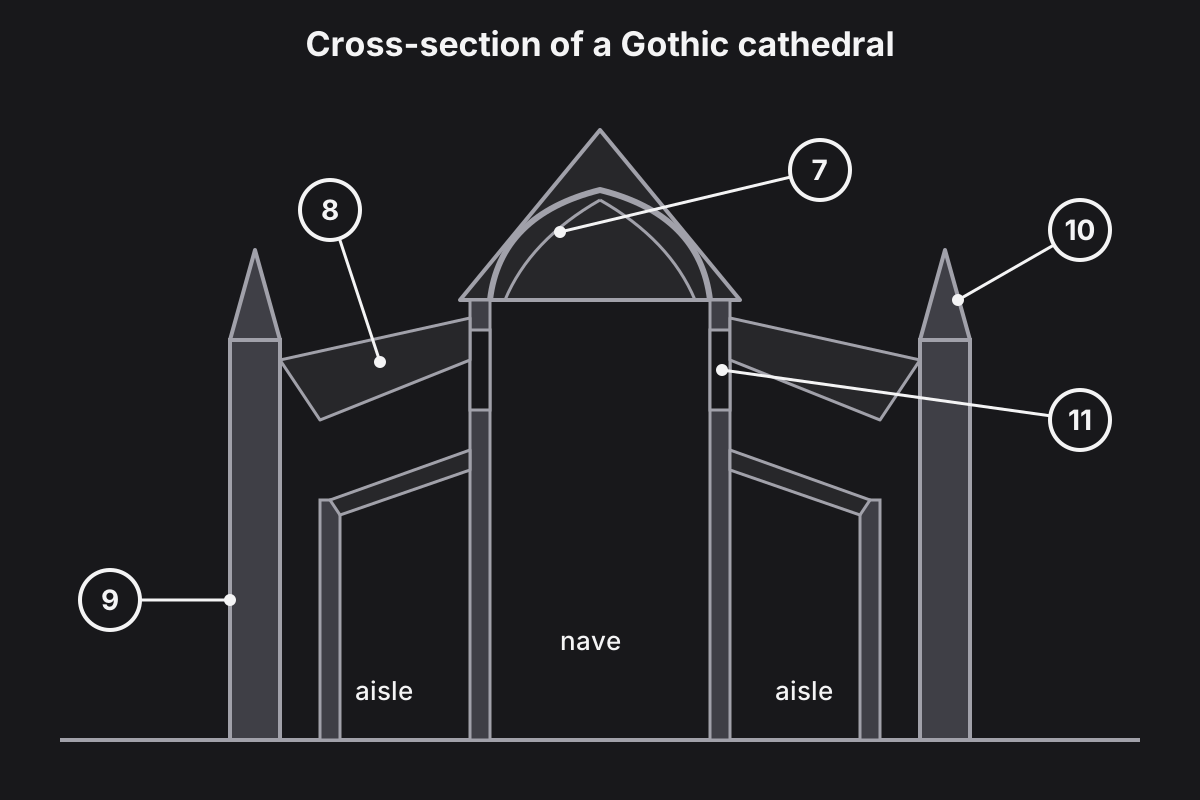
Label the diagram below. Choose NO MORE THAN TWO WORDS from the passage for each answer.
NO MORE THAN TWO WORDS
7 stone (7) ________ of the vault 8 (8) ________ leaning against the upper wall 9 tall, solid (9) ________ outside the building 10 (10) ________ adding weight to the pier 11 (11) ________ windows at the top of the nave
Answers and explanations
Open one at a time to check as you go, or the key to mark them all.
Answer key: Questions 7–11Show
- 7ribs
- 8flying buttress
- 9pier
- 10pinnacle
- 11clerestory
77 stone ________Answer
Answer: ribs
Paragraph D: 'a framework of stone ribs was built first'. 'Panels' are the thinner stone between the ribs.
88 ________Answer
Answer: flying buttress (also accepted: buttress)
Paragraph E: 'the flying buttress ... leans against the upper wall of the nave'. 'Half-arch' describes its shape, not its name.
99 tall, solid ________Answer
Answer: pier
Paragraph E: the buttress 'springs from a tall, solid pier standing outside the building'.
1010 ________Answer
Answer: pinnacle (also accepted: pinnacles)
Paragraph E: 'On top of many piers sits a pinnacle' whose 'weight presses down on the pier'. 'Turret' describes it, but the part is called a pinnacle.
1111 ________Answer
Answer: clerestory (also accepted: the clerestory)
Paragraph F: 'The highest level of the nave, known as the clerestory'. 'Nave' is printed on the diagram.
The rest of this passage
Other question types on the same text, like the paper.
More Diagram Label Completion practice
Common questions
Are these real IELTS Reading questions?
No. They're original practice questions written in the official IELTS format and numbering, with answers and explanations. Real test questions aren't published.
How should I use the answers?
Answer every question first, then check. For each one you got wrong, read the explanation and find the line in the passage that gives the answer: that's where the trap or paraphrase is.
Does spelling count?
Yes. In IELTS Reading a misspelt word is marked wrong, and so is an answer over the word limit in the instructions. British and American spellings are both accepted.
Answer it in the app
See right and wrong at once with the reason for each. Free to start, nothing to install.