IELTS Reading · Reading Passage 1
Country-house ice houses: label the diagram
Diagram Label Completion practice, questions 7–12, with the full passage and every answer explained. Try the questions first; the answers are folded away below.
- Questions
- 7–12
- Passage
- 668 words
- Level
- Medium
- Part
- 2 of 2 on this passage
Ice Houses: Storing Winter for Summer
ALong before the invention of the refrigerator, the wealthier households of Europe enjoyed ice in the height of summer. They cooled drinks with it, used it to make ice cream and sorbets, and preserved fish, meat and dairy produce. The ice was cut from frozen lakes and ponds in winter and stored, often for many months, in a specially designed building known as an ice house. In Britain, where ice houses became fashionable on country estates from the late seventeenth century onwards, several thousand were built, and a large number survive, although many now lie hidden in woodland, their purpose forgotten.
BThe design of an ice house was governed by a single principle: ice melts when it gains heat, so the building had to admit as little heat as possible. For this reason, most were built partly or wholly underground, where the temperature remains cool and stable throughout the year. Builders often chose a shaded, north-facing slope, ideally close to the lake that would supply the ice, and frequently planted trees around the site to provide additional shade.
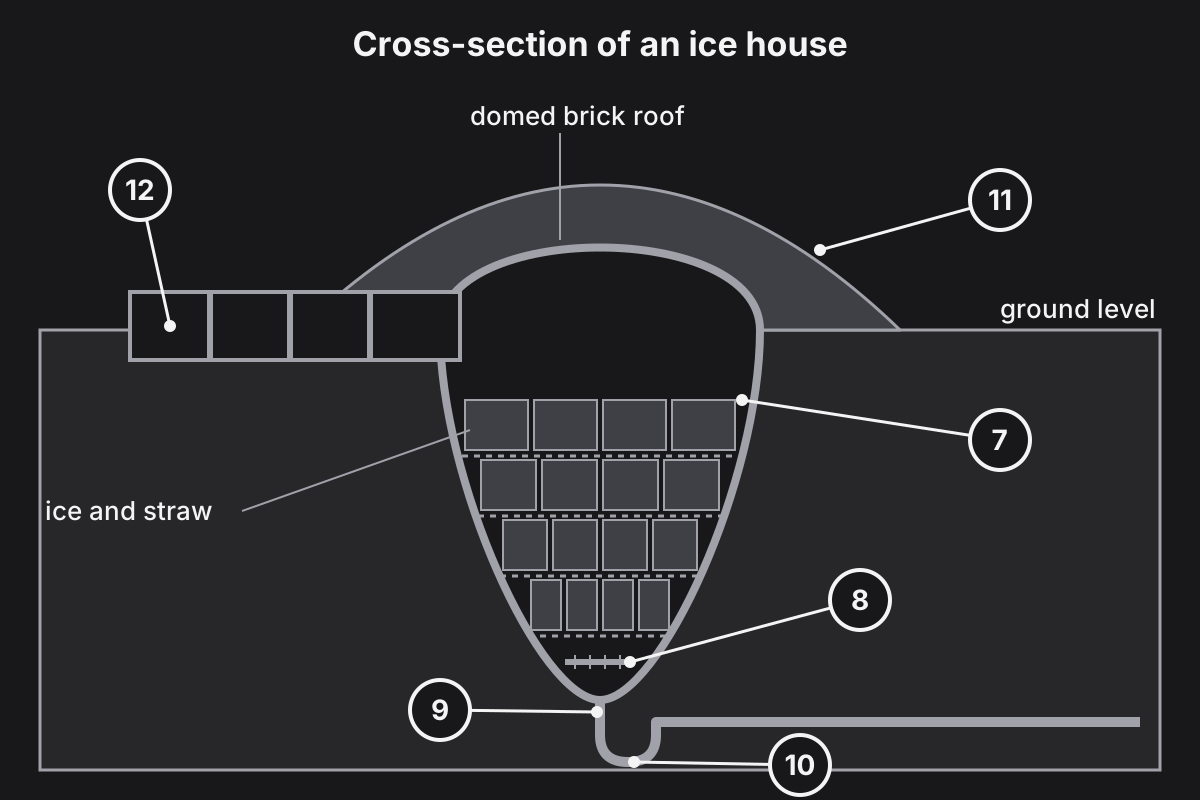
CThe heart of the structure was the ice well, a deep chamber, usually circular, lined with brick or stone and shaped like an upturned egg, with the narrow end at the bottom. This shape was not chosen for appearance. As the ice melted, the mass settled downwards into an ever narrower space, keeping the blocks tightly packed together; a solid mass of ice melts far more slowly than loose fragments, because it exposes less surface to the air. Some ice wells were more than ten metres deep and could hold enough ice to last two years.
DMeltwater posed a serious threat, since ice standing in water melts quickly. At the base of the well, therefore, builders installed a drain, often covered by a wooden grating on which the ice rested. The drain led the water away through a channel, and in many ice houses it was fitted with a water trap, a U-shaped bend that remained filled with water and prevented warm air from flowing back up into the chamber. This detail was easily overlooked by inexperienced builders, and ice houses without it rarely kept their contents through the summer.
EAbove ground, the well was usually covered by a domed brick roof, which was itself buried beneath a thick mound of earth and turf. The earth provided insulation, and the grass that grew on it shaded the brickwork from the sun. Access was through a horizontal entrance passage, which often turned a corner or contained a series of two or three doors. These created pockets of still air between them, so that opening the outer door let in very little warmth from outside; servants were instructed to close each door before opening the next.
FFilling the ice house was heavy work. On the coldest days of winter, estate workers broke the ice on the lake, dragged it ashore and carried it to the house, where it was crushed and packed into the well in layers. Straw was laid between the layers and around the edges of the chamber to insulate the ice, and some owners preferred sawdust, which was considered more effective. One estate account from the 1780s records that eighteen men worked for three days to fill a single large ice house, which gives some sense of how highly the stored ice was valued.
GThe arrival of imported ice changed everything. From the 1840s, ships brought huge blocks of ice across the Atlantic from the lakes of New England and, later, from Norway, and it was cheaper and cleaner than locally cut ice, which was often full of leaves and mud. By the end of the century, mechanical refrigeration had begun to replace natural ice altogether. Historian Dr Fiona Marsh, who has surveyed ice houses across southern England, notes that many owners simply abandoned them, and that the buildings have survived largely because they were too solidly built to be worth demolishing.
Questions 7–12
Label the diagram below. Choose NO MORE THAN TWO WORDS from the passage for each answer.
NO MORE THAN TWO WORDS
7 egg-shaped (7) ________ lined with brick 8 wooden (8) ________ on which the ice rests 9 (9) ________ at the base of the well 10 (10) ________ that keeps warm air out 11 thick (11) ________ of earth and turf 12 (12) ________ with a series of doors
Answers and explanations
Open one at a time to check as you go, or the key to mark them all.
Answer key: Questions 7–12Show
- 7ice well
- 8grating
- 9drain
- 10water trap
- 11mound
- 12entrance passage
77 egg-shaped ________Answer
Answer: ice well (also accepted: well)
Paragraph C: 'the ice well, a deep chamber ... lined with brick or stone and shaped like an upturned egg'.
88 wooden ________Answer
Answer: grating
Paragraph D: 'a drain, often covered by a wooden grating on which the ice rested'.
99 ________Answer
Answer: drain (also accepted: a drain)
Paragraph D: 'At the base of the well, therefore, builders installed a drain'.
1010 ________Answer
Answer: water trap
Paragraph D: 'a water trap, a U-shaped bend that ... prevented warm air from flowing back up'.
1111 thick ________Answer
Answer: mound
Paragraph E: 'buried beneath a thick mound of earth and turf'. The 'domed brick roof' underneath is printed.
1212 ________Answer
Answer: entrance passage (also accepted: passage)
Paragraph E: 'Access was through a horizontal entrance passage, which ... contained a series of two or three doors'.
The rest of this passage
Other question types on the same text, like the paper.
More Diagram Label Completion practice
Common questions
Are these real IELTS Reading questions?
No. They're original practice questions written in the official IELTS format and numbering, with answers and explanations. Real test questions aren't published.
How should I use the answers?
Answer every question first, then check. For each one you got wrong, read the explanation and find the line in the passage that gives the answer: that's where the trap or paraphrase is.
Does spelling count?
Yes. In IELTS Reading a misspelt word is marked wrong, and so is an answer over the word limit in the instructions. British and American spellings are both accepted.
Answer it in the app
See right and wrong at once with the reason for each. Free to start, nothing to install.