IELTS Reading · Reading Passage 1
Pitcher plants: label the diagram
Diagram Label Completion practice, questions 7–12, with the full passage and every answer explained. Try the questions first; the answers are folded away below.
- Questions
- 7–12
- Passage
- 687 words
- Level
- Medium
- Part
- 2 of 2 on this passage
The Pitcher Plant's Deadly Trap
AMost plants obtain the nitrogen and other nutrients they need from the soil through their roots. But in places where the soil is poor, such as peat swamps, sandy heathlands and the thin soils of tropical mountains, some plants have evolved another source: animals. Carnivorous plants have appeared independently several times in the course of evolution, and the tropical pitcher plants of the genus Nepenthes are among the most elaborate. Around 170 species are known, most of them from South-East Asia, and the island of Borneo alone is home to dozens.
BA Nepenthes plant is usually a climbing vine, and its traps grow at the ends of its leaves. Each leaf blade extends into a long, thin tendril, which may coil around a branch to help support the plant. At the tip of the tendril, a small bud swells and gradually develops into a hollow, upright container: the pitcher. In some species, pitchers formed near the ground are squat and rounded, while those produced higher up the vine are slender and funnel-shaped, and the two kinds may even attract different prey.
CAbove the mouth of the pitcher is the lid, a flap that, in most species, stays open once the pitcher has matured. For a long time it was assumed that the lid's main job was to keep out rain, which would otherwise dilute the digestive fluid inside, and this does seem to be true in many species. The underside of the lid also carries glands that produce nectar, and it is this sweet reward, together with the pitcher's colours and, in some cases, its scent, that draws insects towards the trap.
DThe most important part of the trap, however, is the peristome, a ridged and often brightly coloured rim around the mouth of the pitcher. It too produces nectar, and insects walk onto it to feed. Researchers Holger Bohn and Walter Federle showed in 2004 that the peristome works by becoming extremely slippery when wet. A thin film of water, from rain, dew or high humidity, spreads across the ridged surface, and insects lose their grip in much the same way that a car tyre loses contact with a wet road: they aquaplane. When the rim is dry, ants can walk across it safely; when it is wet, they slide into the pitcher.
EInside, the upper part of the pitcher wall is covered in tiny flakes of wax, which form the waxy zone. These flakes break off and stick to the feet of any insect that tries to climb out, so that it cannot grip the surface. Below this lies the digestive zone, where the wall is lined with thousands of glands. These release enzymes into the pool of fluid at the bottom of the pitcher, and the fluid gradually breaks down the soft parts of drowned prey, which the plant then absorbs. In some species, the fluid is sticky and stringy, so that a struggling insect is drawn back down even if it reaches the wall.
FAnts are the most common victims, but the diet varies widely. The largest pitchers, such as those of Nepenthes rajah on Mount Kinabalu, can hold more than two litres of fluid and very occasionally trap small vertebrates, including frogs and even rats. Some species have abandoned hunting animals almost entirely. Nepenthes lowii, which grows on mountains in Borneo, produces pitchers whose lids secrete a buttery substance eaten by tree shrews; while feeding, the animals leave their droppings in the pitcher, which supply the plant with nitrogen.
GEqually surprising is Nepenthes hemsleyana, whose pitchers serve as daytime roosts for a small species of woolly bat. The bats gain a safe, parasite-free shelter, and the plant gains the nitrogen in their droppings. Ecologist Dr Lena Park argues that such partnerships show how flexible carnivory can be: a structure that evolved as a trap can become, over time, a place where animals choose to live. Many pitcher plants are now threatened by the clearance of forests for agriculture and by illegal collection for the plant trade, and several species are known from only one mountain.
Questions 7–12
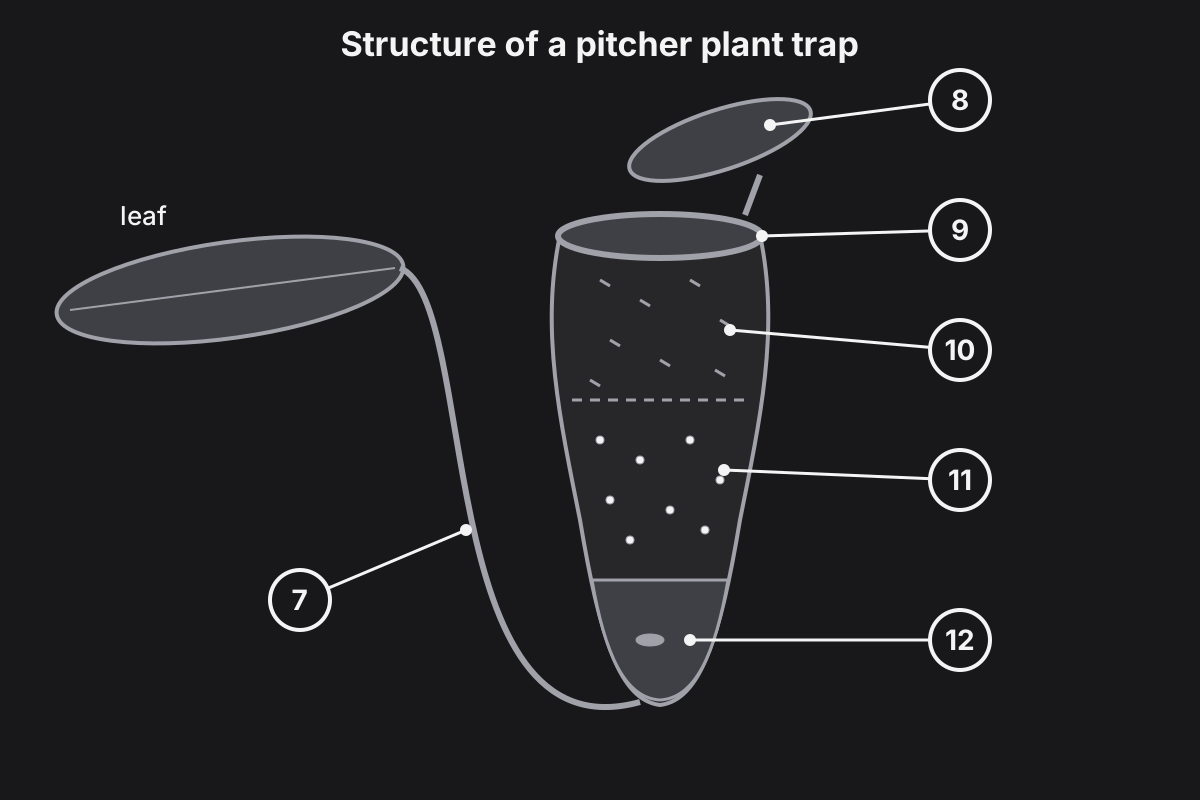
Label the diagram below. Choose NO MORE THAN TWO WORDS from the passage for each answer.
NO MORE THAN TWO WORDS
7 (7) ________ joining the pitcher to the leaf 8 (8) ________ with nectar glands underneath 9 slippery (9) ________ around the mouth 10 (10) ________ on the upper inside wall 11 (11) ________ lined with glands 12 pool of (12) ________ containing enzymes
Answers and explanations
Open one at a time to check as you go, or the key to mark them all.
Answer key: Questions 7–12Show
- 7tendril
- 8lid
- 9peristome
- 10waxy zone
- 11digestive zone
- 12fluid
77 ________Answer
Answer: tendril
Paragraph B: 'Each leaf blade extends into a long, thin tendril' with the pitcher at its tip.
88 ________Answer
Answer: lid (also accepted: the lid)
Paragraph C: 'The underside of the lid also carries glands that produce nectar'. 'Flap' describes it, but 'lid' is its name.
99 slippery ________Answer
Answer: peristome
Paragraph D: 'the peristome, a ridged and often brightly coloured rim around the mouth'. 'Rim' describes it; the part's name is 'peristome'.
1010 ________Answer
Answer: waxy zone
Paragraph E: 'the upper part of the pitcher wall is covered in tiny flakes of wax, which form the waxy zone'.
1111 ________Answer
Answer: digestive zone
Paragraph E: 'Below this lies the digestive zone, where the wall is lined with thousands of glands'.
1212 pool of ________Answer
Answer: fluid (also accepted: digestive fluid)
Paragraph E: glands 'release enzymes into the pool of fluid at the bottom of the pitcher'.
The rest of this passage
Other question types on the same text, like the paper.
More Diagram Label Completion practice
Common questions
Are these real IELTS Reading questions?
No. They're original practice questions written in the official IELTS format and numbering, with answers and explanations. Real test questions aren't published.
How should I use the answers?
Answer every question first, then check. For each one you got wrong, read the explanation and find the line in the passage that gives the answer: that's where the trap or paraphrase is.
Does spelling count?
Yes. In IELTS Reading a misspelt word is marked wrong, and so is an answer over the word limit in the instructions. British and American spellings are both accepted.
Answer it in the app
See right and wrong at once with the reason for each. Free to start, nothing to install.