IELTS Reading · Reading Passage 1
How geysers erupt: label the diagram
Diagram Label Completion practice, questions 1–6, with the full passage and every answer explained. Try the questions first; the answers are folded away below.
- Questions
- 1–6
- Passage
- 660 words
- Level
- Medium
- Part
- 1 of 2 on this passage
How Geysers Work
AOf all the features of volcanic landscapes, few draw crowds like a geyser. At regular or irregular intervals, a column of boiling water and steam bursts from the ground, sometimes rising tens of metres into the air, before the activity dies away and the pool at its base falls silent once more. The word itself comes from Geysir, a spring in south-west Iceland whose eruptions were famous in medieval times, although Geysir itself is now largely dormant and visitors watch its neighbour, Strokkur, which erupts every few minutes. Yet geysers are rare: only around a thousand are known worldwide, and roughly half of them are found in a single place, Yellowstone National Park in the United States.
BThe rarity is explained by the unusual combination of conditions that a geyser needs. The first is an intense source of heat close to the surface. In geyser fields, a body of magma, or molten rock, lies a few kilometres underground and warms the surrounding rock to very high temperatures. The second is a plentiful supply of water. Rain and melted snow seep down through cracks and porous layers in the ground, sometimes taking decades to reach the depths where they are heated.
CThe third, and most distinctive, requirement is a particular type of underground plumbing. Beneath most geysers lies a network of fractures and cavities in which heated water collects; in many cases this includes one or more larger chambers that act as reservoirs. These are connected to the surface by a narrow vertical channel. Crucially, somewhere along that channel there is a constriction, a point where the passage narrows sharply. Without it, hot water would simply rise steadily and escape as a hot spring.
DThe eruption itself depends on the effect of pressure on the boiling point of water. At the surface, water boils at about 100°C, but deep underground the weight of the water column above raises its boiling point considerably, so the water in the reservoir can reach temperatures well above 100°C without boiling. As heating continues, bubbles of steam eventually form, rise and become trapped below the constriction. When enough have gathered, they push some water out of the vent at the surface, which is often seen as a small overflow or preliminary splashing.
EThis loss of water sets off a chain reaction. With less water above it, the pressure on the superheated water in the reservoir falls, and its boiling point drops below its actual temperature. Large volumes of water flash into steam almost instantly, expanding to many hundreds of times their original volume, and the mixture of steam and water is forced violently up the channel and out of the vent. The eruption continues until the reservoir is largely empty or has cooled, after which it slowly refills and the cycle begins again.
FAround the vent, many geysers build up mounds or cones of a grey or white mineral called sinter, also known as geyserite. The hot water dissolves silica from the volcanic rock it passes through, and as it cools at the surface, the silica is deposited in thin layers. These deposits matter for the geyser's survival, because sinter lines the channel and helps to seal it, keeping the pressure inside the system high. Growth is extremely slow, often less than a millimetre a year.
GGeysers are also remarkably fragile. Earthquakes can open new fractures, diverting the water or relieving the pressure, and several geysers have changed their behaviour or fallen silent after one. Human activity has proved even more destructive. In New Zealand, the drilling of wells for geothermal heating in the town of Rotorua in the twentieth century caused many geysers to weaken or stop erupting, and in Nevada, geothermal power development is thought to have destroyed the geysers of the Steamboat Springs field. Volcanologist Dr Ana Ferreira compares a geyser to 'a finely tuned instrument: alter almost any part of it and it stops playing'.
Questions 1–6
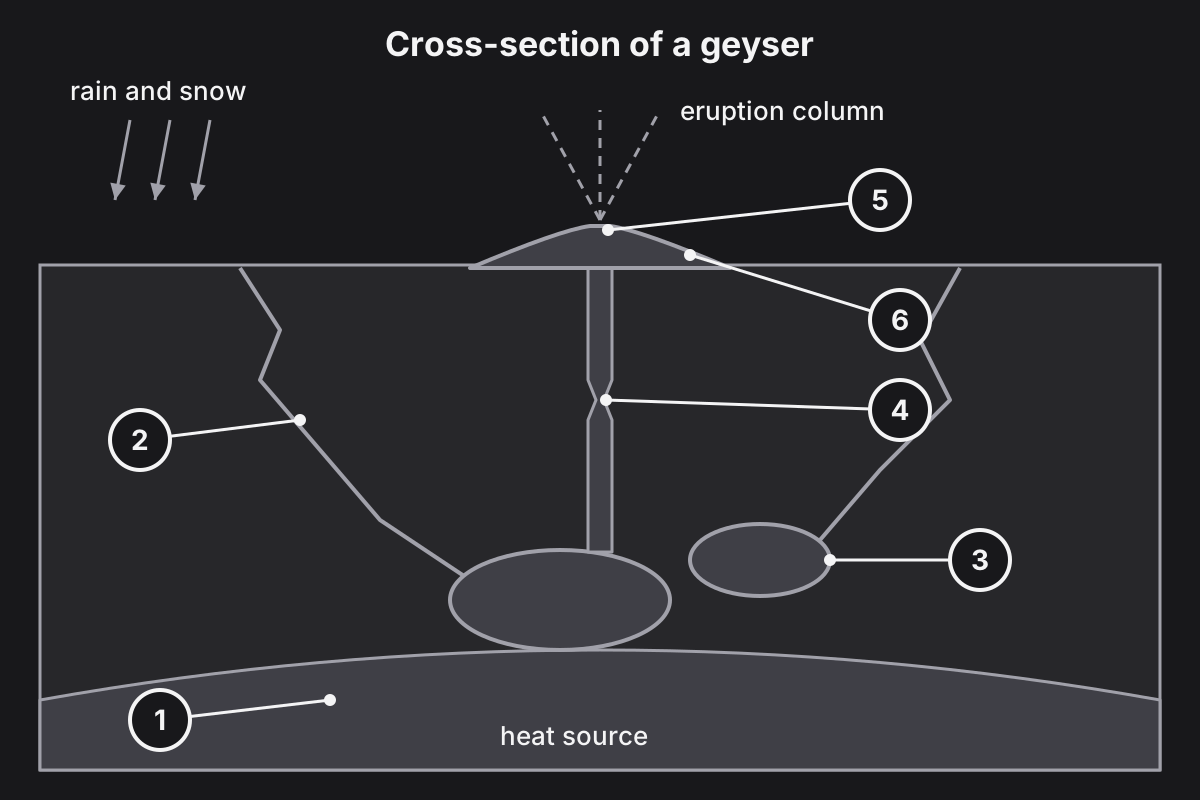
Label the diagram below. Choose ONE WORD ONLY from the passage for each answer.
ONE WORD ONLY
1 (1) ________ heating the rock from below 2 water seeping down through (2) ________ 3 larger (3) ________ where heated water is stored 4 (4) ________ in the narrow channel 5 (5) ________ where water and steam escape 6 mound of (6) ________
Answers and explanations
Open one at a time to check as you go, or the key to mark them all.
Answer key: Questions 1–6Show
- 1magma
- 2cracks
- 3chambers
- 4constriction
- 5vent
- 6sinter
11 ________Answer
Answer: magma
Paragraph B: 'a body of magma, or molten rock, lies a few kilometres underground'. 'Molten rock' is two words, over the limit.
22 water seeping down through ________Answer
Answer: cracks
Paragraph B: 'Rain and melted snow seep down through cracks and porous layers'. 'Porous layers' is two words.
33 larger ________Answer
Answer: chambers (also accepted: chamber, reservoirs, reservoir)
Paragraph C: 'one or more larger chambers that act as reservoirs'.
44 ________Answer
Answer: constriction
Paragraph C: 'a constriction, a point where the passage narrows sharply'.
55 ________Answer
Answer: vent
Paragraphs D and E: water is pushed 'out of the vent at the surface'. 'Channel' is the passage below the surface.
66 mound of ________Answer
Answer: sinter (also accepted: geyserite)
Paragraph F: 'mounds or cones of a grey or white mineral called sinter, also known as geyserite'. 'Silica' is what it is made from, not its name.
The rest of this passage
Other question types on the same text, like the paper.
More Diagram Label Completion practice
Common questions
Are these real IELTS Reading questions?
No. They're original practice questions written in the official IELTS format and numbering, with answers and explanations. Real test questions aren't published.
How should I use the answers?
Answer every question first, then check. For each one you got wrong, read the explanation and find the line in the passage that gives the answer: that's where the trap or paraphrase is.
Does spelling count?
Yes. In IELTS Reading a misspelt word is marked wrong, and so is an answer over the word limit in the instructions. British and American spellings are both accepted.
Answer it in the app
See right and wrong at once with the reason for each. Free to start, nothing to install.