IELTS Reading · Reading Passage 1
Termite mounds: label the diagram
Diagram Label Completion practice, questions 1–6, with the full passage and every answer explained. Try the questions first; the answers are folded away below.
- Questions
- 1–6
- Passage
- 687 words
- Level
- Medium
- Part
- 1 of 2 on this passage
Living Architecture: The Termite Mound
AAcross the savannas of southern and eastern Africa, the landscape is dotted with towers of hardened earth, some rising more than five metres above the ground. They are built by termites of the genus Macrotermes, insects only a few millimetres long, and they are among the largest structures made by any animal other than humans. Measured against the size of their builders, a large mound is the equivalent of a skyscraper well over a kilometre high. Yet the most remarkable part of the structure is not the tower that we see but what lies beneath it.
BThe colony itself, which may contain more than a million individuals, lives not in the tower but in a roughly spherical nest below ground level, at the base of the mound. At its centre is the royal chamber, a thick-walled cell in which the queen and king live. The queen, whose swollen abdomen may reach several centimetres in length, can lay thousands of eggs a day, and she is tended constantly by workers, who carry the eggs away to nursery chambers.
CSurrounding the royal chamber are the fungus gardens, for which these termites are best known. Workers gather dead grass and wood from the surrounding area, chew it and deposit it in the gardens, where it is used to grow a fungus. The fungus breaks down the tough plant material, which the termites cannot digest efficiently themselves, and the termites then feed on the fungus and the partly digested material. Like any farm, the gardens need stable conditions: the fungus grows well only within a narrow range of temperature and humidity.
DAbove the nest rises the tower, which is far from solid. A large central chimney runs up through its core, branching into a network of smaller passages that approach the outer surface. The outer walls are porous: the soil particles from which they are made are cemented with the termites' saliva in such a way that tiny pores remain, allowing gases to pass through while keeping out rain and predators. Beneath the nest, meanwhile, a system of tunnels extends far into the surrounding soil, and in some regions workers dig shafts many metres deep to reach moist earth, bringing up damp soil that helps to keep the nest humid.
EFor decades, the mound was described as a natural air-conditioning system. According to the traditional account, heat produced by the colony and its fungus warmed the air in the nest, which rose up the chimney and escaped through the walls at the top, drawing in cooler air from below. This explanation was widely repeated in textbooks and even inspired buildings: the Eastgate Centre in Harare, Zimbabwe, an office and shopping complex completed in 1996, was designed to be ventilated naturally in a way its architect likened to a termite mound, and uses a fraction of the energy of conventional buildings of a similar size.
FMore recent research has complicated this picture. Measurements inside mounds in Namibia and India showed that the air does not flow in a steady stream at all. Instead, the movement of air is driven by the daily cycle of temperature. During the day, the thin outer passages warm up more quickly than the central chimney, and air rises near the surface and sinks in the core; at night the pattern reverses. This regular shifting moves stale air, rich in carbon dioxide, out of the nest and towards the porous walls, where it is exchanged with the atmosphere. Biologist Dr Rebecca Hale compares the mound less to an air conditioner than to a lung that 'breathes' once a day.
GEngineers are now studying the mounds for new reasons. The porous walls, which allow air to be exchanged without letting water in, have attracted interest from designers of building materials, and the termites' ability to construct such complex structures without any central plan has inspired research into swarm robotics, in which large numbers of simple machines cooperate to complete a task. As Hale puts it, the termites solve problems not by being clever individually, but by following a few simple rules together.
Questions 1–6
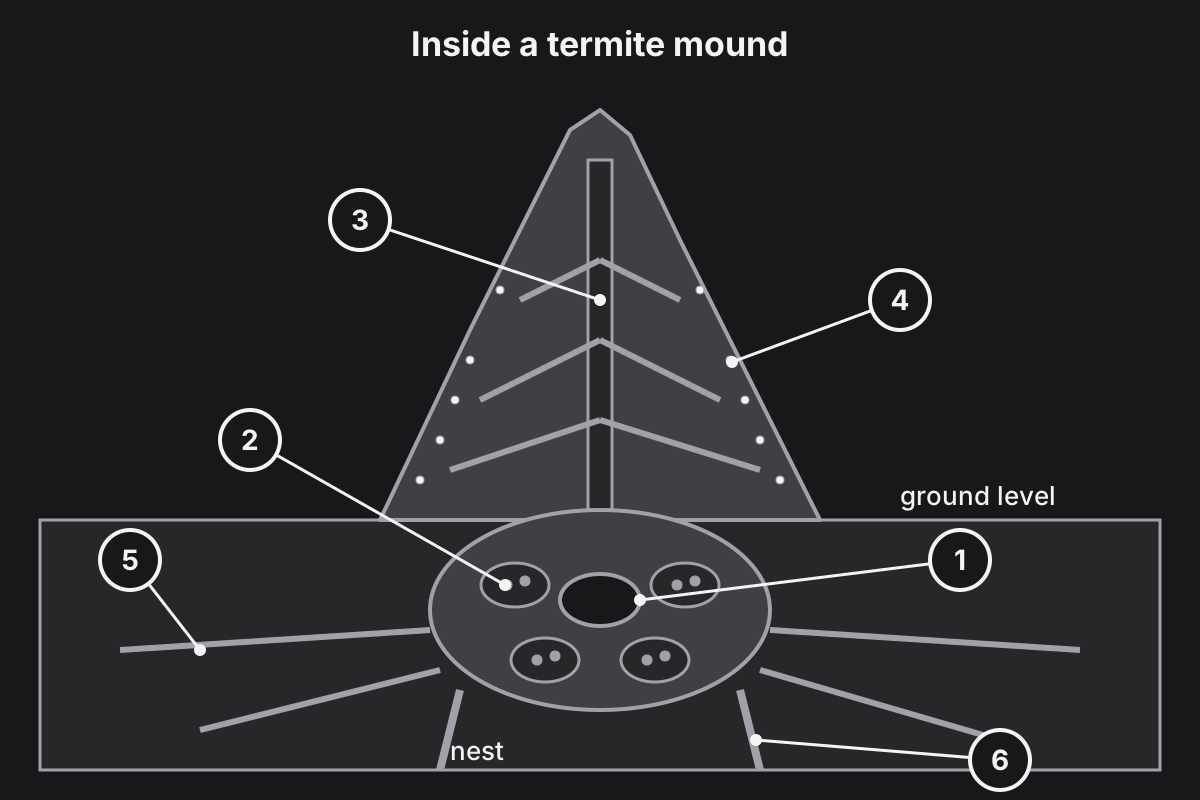
Label the diagram below. Choose NO MORE THAN TWO WORDS from the passage for each answer.
NO MORE THAN TWO WORDS
1 (1) ________ containing the queen and king 2 (2) ________ where workers grow food 3 central (3) ________ running up the tower 4 tiny (4) ________ in the outer walls 5 (5) ________ spreading into the surrounding soil 6 deep (6) ________ dug to reach moist earth
Answers and explanations
Open one at a time to check as you go, or the key to mark them all.
Answer key: Questions 1–6Show
- 1royal chamber
- 2fungus gardens
- 3chimney
- 4pores
- 5tunnels
- 6shafts
11 ________Answer
Answer: royal chamber
Paragraph B: 'the royal chamber, a thick-walled cell in which the queen and king live'. 'Nursery chambers' hold the eggs, not the queen.
22 ________Answer
Answer: fungus gardens (also accepted: gardens)
Paragraph C: 'the fungus gardens', where plant material 'is used to grow a fungus'.
33 central ________Answer
Answer: chimney
Paragraph D: 'A large central chimney runs up through its core'. 'Central' is printed.
44 tiny ________Answer
Answer: pores
Paragraph D: 'tiny pores remain, allowing gases to pass through'. 'Porous' is the adjective; the gap needs the noun.
55 ________Answer
Answer: tunnels
Paragraph D: 'a system of tunnels extends far into the surrounding soil'. 'Passages' are inside the tower.
66 deep ________Answer
Answer: shafts
Paragraph D: 'workers dig shafts many metres deep to reach moist earth'.
The rest of this passage
Other question types on the same text, like the paper.
More Diagram Label Completion practice
Common questions
Are these real IELTS Reading questions?
No. They're original practice questions written in the official IELTS format and numbering, with answers and explanations. Real test questions aren't published.
How should I use the answers?
Answer every question first, then check. For each one you got wrong, read the explanation and find the line in the passage that gives the answer: that's where the trap or paraphrase is.
Does spelling count?
Yes. In IELTS Reading a misspelt word is marked wrong, and so is an answer over the word limit in the instructions. British and American spellings are both accepted.
Answer it in the app
See right and wrong at once with the reason for each. Free to start, nothing to install.