IELTS Reading · Reading Passage 1
Iranian qanats: label the diagram
Diagram Label Completion practice, questions 1–6, with the full passage and every answer explained. Try the questions first; the answers are folded away below.
- Questions
- 1–6
- Passage
- 736 words
- Level
- Medium
- Part
- 1 of 2 on this passage
The Qanats of the Iranian Plateau
AFor close to three thousand years, farmers on the arid plateaus of Iran have drawn water from beneath the ground without pumps, engines or any source of power other than gravity. Their method, the qanat, is a gently sloping tunnel that taps groundwater at the foot of a mountain range and leads it, sometimes for many kilometres, to fields and villages on the plain below. Similar systems spread across the Middle East, North Africa and Central Asia, and were later carried to Spain and, from there, to parts of Latin America. In Iran alone, tens of thousands are thought to have been built, and a significant number still flow today.
BBuilding a qanat began with a search for water. An experienced digger, known as a muqanni, would examine the alluvial fans where streams leave the mountains, looking for signs such as unusual patches of vegetation. Once a promising site had been chosen, a trial pit was sunk. If it struck a reliable aquifer, this became the mother well, the deepest point of the entire system; in some cases it descended more than a hundred metres before reaching water. The diggers then measured the depth of the water table and calculated the slope the tunnel would need in order to reach the surface at the chosen destination.
CThe tunnel itself was excavated from the far end, working back towards the source. This was a deliberate choice: had the diggers started at the mother well, they would have been flooded as soon as they broke into the water-bearing layer. Instead, they dug a series of vertical shafts at intervals of twenty to fifty metres along the planned route. These provided ventilation for the men working underground and allowed the excavated earth to be hauled up in leather buckets by a windlass. The spoil was piled in a ring around the mouth of each shaft, and from the air a qanat still looks like a long line of craters stretching across the desert.
DConnecting the bottoms of the shafts was the gallery, the almost horizontal channel through which the water actually travels. Its gradient was critical. Too steep, and fast-flowing water would scour the floor and cause the roof to collapse; too shallow, and the flow would stagnate and deposit silt. Most galleries fall by between one and two metres per kilometre, a precision achieved with nothing more sophisticated than lamps, cords and plumb lines. Where the soil was loose, the diggers lined the gallery with hoops of fired clay to keep it open.
EEventually the gallery emerges into daylight at the outlet, which Iranians call the mazhar. From here the water runs along open channels to the fields, each farmer receiving a share measured not in volume but in time. Traditionally a water clock, consisting of a bowl with a small hole in its base that slowly sank in a larger vessel, was used to time each allocation, and a respected official kept the records. In many villages the water first passed through a cistern, a covered reservoir where drinking water could be stored, before continuing to the fields.
FThe advantages of the system are considerable. Because the water travels underground, very little is lost to evaporation, a decisive benefit in a climate where summer temperatures exceed forty degrees. A qanat also cannot take more water than the aquifer naturally yields, so, unlike a modern borehole, it does not empty the reserve beneath it. Hydrologist Dr Leila Moradi, who has surveyed more than two hundred qanats in Kerman province, describes them as 'self-limiting': the flow rises after a wet winter and falls in a drought, but it never exhausts the source.
GYet the qanats are in decline. Maintenance is dangerous, poorly paid work, and fewer young people are willing to train as muqannis. More seriously, the spread of motorised wells since the 1960s has lowered water tables across the plateau, leaving many mother wells dry. Moradi's survey found that almost a third of the systems she visited had stopped flowing within the past forty years. Some engineers argue that the qanat belongs to the past; others, including Moradi, believe that the principle behind it, taking only what the ground can replace, is exactly what modern water policy needs. In 2016, eleven Iranian qanats were added to UNESCO's World Heritage List, a recognition that may help to secure funding for their repair.
Questions 1–6
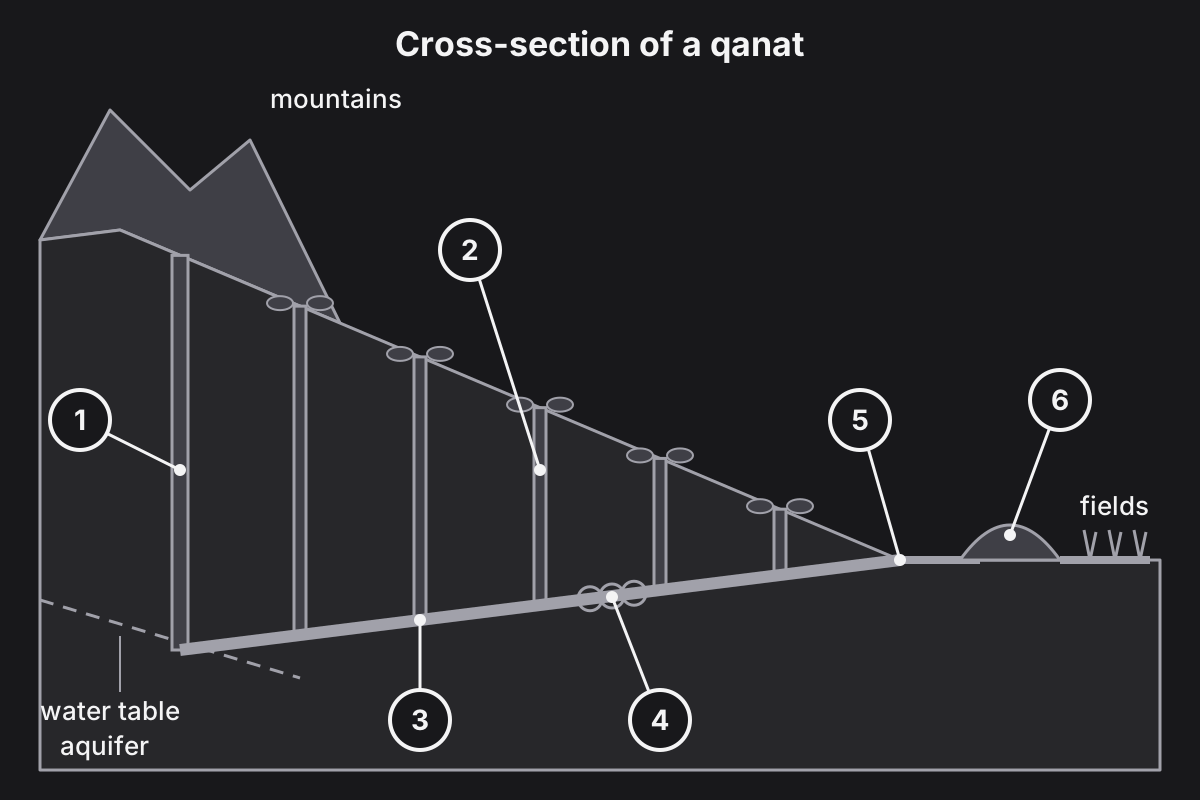
Label the diagram below. Choose NO MORE THAN TWO WORDS from the passage for each answer.
NO MORE THAN TWO WORDS
1 deepest point of the system: the (1) ________ 2 (2) ________ for air and removing earth 3 sloping (3) ________ (falls 1–2 m per km) 4 hoops of (4) ________ where the soil is loose 5 (5) ________ where water reaches daylight 6 covered (6) ________ for drinking water
Answers and explanations
Open one at a time to check as you go, or the key to mark them all.
Answer key: Questions 1–6Show
- 1mother well
- 2vertical shafts
- 3gallery
- 4fired clay
- 5outlet
- 6cistern
11 deepest point of the system: the ________Answer
Answer: mother well
Paragraph B: the trial pit 'became the mother well, the deepest point of the entire system'. 'Trial pit' is only what it was before water was found.
22 ________Answer
Answer: vertical shafts (also accepted: shafts)
Paragraph C: the 'vertical shafts' gave 'ventilation' and let the earth be 'hauled up'. 'Windlass' is the lifting device, not the shaft itself.
33 sloping ________Answer
Answer: gallery
Paragraph D: 'the gallery, the almost horizontal channel through which the water actually travels'. 'Tunnel' is the general word; the label asks for the part's name.
44 hoops of ________Answer
Answer: fired clay (also accepted: clay)
Paragraph D: 'lined the gallery with hoops of fired clay'. 'Hoops' is already printed, so do not repeat it.
55 ________Answer
Answer: outlet (also accepted: the outlet, mazhar, the mazhar)
Paragraph E: 'the gallery emerges into daylight at the outlet, which Iranians call the mazhar'. Either name fits the gap.
66 covered ________Answer
Answer: cistern (also accepted: reservoir)
Paragraph E: 'a cistern, a covered reservoir where drinking water could be stored'. 'Covered' is printed, so write only the noun.
The rest of this passage
Other question types on the same text, like the paper.
More Diagram Label Completion practice
Common questions
Are these real IELTS Reading questions?
No. They're original practice questions written in the official IELTS format and numbering, with answers and explanations. Real test questions aren't published.
How should I use the answers?
Answer every question first, then check. For each one you got wrong, read the explanation and find the line in the passage that gives the answer: that's where the trap or paraphrase is.
Does spelling count?
Yes. In IELTS Reading a misspelt word is marked wrong, and so is an answer over the word limit in the instructions. British and American spellings are both accepted.
Answer it in the app
See right and wrong at once with the reason for each. Free to start, nothing to install.