IELTS Reading · Reading Passage 1
Desalination by reverse osmosis: label the diagram
Diagram Label Completion practice, questions 1–6, with the full passage and every answer explained. Try the questions first; the answers are folded away below.
- Questions
- 1–6
- Passage
- 706 words
- Level
- Harder
- Part
- 1 of 2 on this passage
Turning Seawater into Drinking Water
ALess than one per cent of the water on Earth is fresh water that is readily accessible for human use. The oceans, by contrast, hold about ninety-seven per cent of the total, and in regions where rivers and aquifers can no longer meet demand, governments have increasingly turned to the sea. There are now more than fifteen thousand desalination plants worldwide, concentrated above all in the Middle East and North Africa, but also found in Australia, Spain, the United States and many island nations. Most of the plants built in recent decades use a process called reverse osmosis.
BTo understand the process, it helps to begin with ordinary osmosis. When two solutions of different strength are separated by a semi-permeable membrane, one that lets water molecules through but blocks dissolved salts, water naturally moves from the weaker solution into the stronger one until the concentrations are more nearly equal. Reverse osmosis turns this tendency on its head. By applying a pressure greater than the natural osmotic pressure to the salty side, engineers force water to flow the other way, out of the seawater and through the membrane, leaving the salt behind. For seawater, this requires pressures of roughly 55 to 80 bar, around thirty times the pressure in a car tyre.
CA typical plant begins with an intake, a pipe that draws seawater from some distance offshore, often several metres below the surface, where the water is cleaner and fish are less likely to be drawn in. Screens at the mouth of the intake keep out larger organisms and debris. The water then passes through a stage known as pre-treatment, in which sand filters or fine membranes remove suspended particles, algae and bacteria. This stage is easily overlooked, but plant managers regard it as critical, because the reverse osmosis membranes are extremely thin and are quickly clogged or damaged by anything that reaches them.
DNext, a high-pressure pump raises the pressure of the filtered water to the level required. The water is then fed into long pressure vessels, each containing several membrane elements made of sheets of membrane wound in a spiral around a central collecting tube. As the seawater flows along the vessel, fresh water, known as permeate, passes through the membrane and into the central tube. Only around forty to fifty per cent of the seawater is converted in this way; the remainder becomes a concentrated salt solution called brine, which leaves the far end of the vessel, still at high pressure.
EThat pressure represents a great deal of energy, and much of it would be wasted if the brine were simply discharged. Modern plants therefore pass it through an energy recovery device, which transfers its pressure to incoming seawater before the brine is released. Devices of this kind can recover more than ninety per cent of the energy in the brine stream, and their spread since the 1990s is one of the main reasons why the energy needed to desalinate a cubic metre of seawater is now only a fraction of what it was in the 1970s.
FThe permeate is almost free of salt, but it is not yet ready to drink. Because it contains so few dissolved minerals, it is slightly corrosive and would attack metal pipes; it also lacks the calcium and magnesium that give drinking water its taste. In the post-treatment stage, therefore, minerals such as lime are added to stabilise the water, and it is disinfected, usually with chlorine, before being pumped into storage tanks and the public supply.
GDesalination remains controversial. Even with energy recovery, the process uses far more electricity than treating river or groundwater, and unless that electricity comes from renewable sources, it adds to greenhouse gas emissions. The disposal of brine is also a concern: discharged carelessly, the dense, salty water can sink to the seabed and harm marine life. Engineer Dr Tomas Lindgren argues that well-designed outfalls, which spread the brine through many small openings so that it mixes rapidly with the surrounding sea, can reduce this effect substantially. Critics reply that the cheapest litre of water is still the one that is never used, and that reducing leaks and waste should come before building new plants.
Questions 1–6
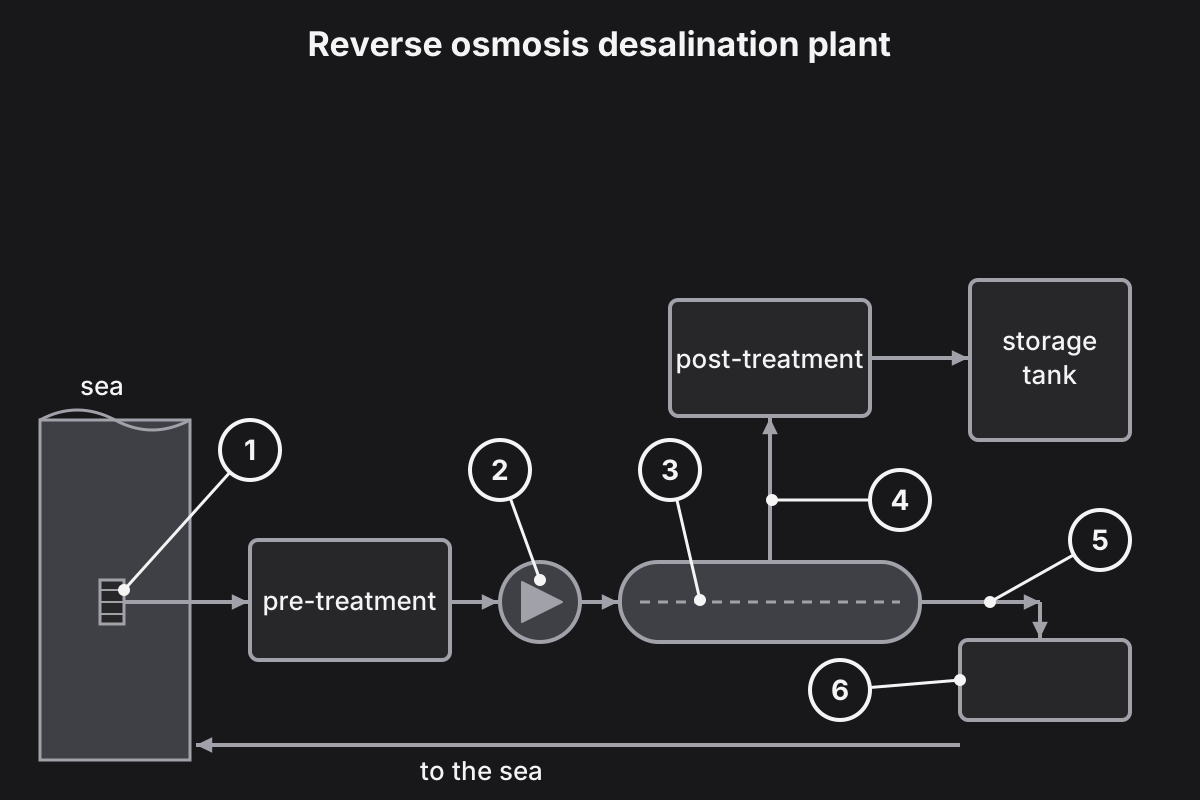
Label the diagram below. Choose NO MORE THAN THREE WORDS from the passage for each answer.
NO MORE THAN THREE WORDS
1 (1) ________ at the mouth of the intake 2 (2) ________ 3 long (3) ________ containing membrane elements 4 fresh water, or (4) ________, sent for post-treatment 5 concentrated salt solution, or (5) ________ 6 (6) ________ that transfers its pressure
Answers and explanations
Open one at a time to check as you go, or the key to mark them all.
Answer key: Questions 1–6Show
- 1screens
- 2high-pressure pump
- 3pressure vessels
- 4permeate
- 5brine
- 6energy recovery device
11 ________Answer
Answer: screens
Paragraph C: 'Screens at the mouth of the intake keep out larger organisms'. 'Intake' is already printed in the label.
22 ________Answer
Answer: high-pressure pump (also accepted: high pressure pump, pump)
Paragraph D: 'a high-pressure pump raises the pressure of the filtered water'.
33 long ________Answer
Answer: pressure vessels (also accepted: pressure vessel)
Paragraph D: 'fed into long pressure vessels, each containing several membrane elements'. 'Membrane elements' is printed, so it cannot be the answer.
44 fresh water, or ________Answer
Answer: permeate
Paragraph D: 'fresh water, known as permeate, passes through the membrane'. Do not write 'fresh water': it is printed.
55 concentrated salt solution, or ________Answer
Answer: brine
Paragraph D: 'the remainder becomes a concentrated salt solution called brine'.
66 ________Answer
Answer: energy recovery device (also accepted: recovery device)
Paragraph E: brine passes 'through an energy recovery device, which transfers its pressure to incoming seawater'. Three words: within the limit.
The rest of this passage
Other question types on the same text, like the paper.
More Diagram Label Completion practice
Common questions
Are these real IELTS Reading questions?
No. They're original practice questions written in the official IELTS format and numbering, with answers and explanations. Real test questions aren't published.
How should I use the answers?
Answer every question first, then check. For each one you got wrong, read the explanation and find the line in the passage that gives the answer: that's where the trap or paraphrase is.
Does spelling count?
Yes. In IELTS Reading a misspelt word is marked wrong, and so is an answer over the word limit in the instructions. British and American spellings are both accepted.
Answer it in the app
See right and wrong at once with the reason for each. Free to start, nothing to install.