IELTS Reading · Reading Passage 1
How the ear works: label the diagram
Diagram Label Completion practice, questions 1–6, with the full passage and every answer explained. Try the questions first; the answers are folded away below.
- Questions
- 1–6
- Passage
- 699 words
- Level
- Harder
- Part
- 1 of 2 on this passage
How We Hear
AHearing is one of the most finely tuned of the human senses. A healthy young adult can detect sounds with frequencies from about 20 to 20,000 hertz, and can tell apart two tones that differ by only a fraction of one per cent. Yet the organ responsible for this performance is remarkably small: the most important parts of the ear would fit comfortably inside a thimble, and they lie protected within one of the densest bones in the body, the temporal bone of the skull.
BThe visible part of the ear, the pinna, acts as a funnel. Its folds of cartilage collect sound waves and direct them into the ear canal, a tube about two and a half centimetres long. The shape of the pinna also slightly alters sounds depending on whether they come from above, below, in front or behind, and the brain uses these differences to help locate where a sound is coming from. The canal itself is lined with skin that produces wax, which traps dust and discourages insects.
CAt the inner end of the canal lies the eardrum, a thin, cone-shaped membrane stretched tightly across the passage. When sound waves strike it, it vibrates in step with them. Beyond the eardrum is the middle ear, an air-filled cavity containing the three smallest bones in the body, known together as the ossicles. The first, the hammer, is attached to the eardrum; it passes vibrations to the anvil, which in turn passes them to the stirrup. The base of the stirrup fits into a small opening in the bone called the oval window.
DThe ossicles do more than simply pass vibrations along. Sound travels easily through air but poorly from air into liquid, and the inner ear is filled with fluid. If sound struck that fluid directly, most of its energy would be reflected away. The middle ear overcomes this problem in two ways. The eardrum has an area roughly seventeen times larger than the oval window, so the force collected over the drum is concentrated onto a much smaller surface, and the ossicles act as a system of levers that further increases the force. Together, these effects raise the pressure by more than twenty times. A narrow passage, the Eustachian tube, connects the middle ear to the back of the throat and keeps the air pressure on both sides of the eardrum equal, which is why swallowing can relieve discomfort during a flight.
EThe oval window opens into the cochlea, a coiled, snail-shaped tube about the size of a pea. Running along the length of the cochlea is the basilar membrane, which is narrow and stiff at the end nearest the oval window and wider and more flexible at the far end. When the stirrup pushes on the oval window, it sets up a wave in the cochlear fluid, and different frequencies make different parts of the membrane vibrate most strongly: high-pitched sounds near the base, low-pitched sounds near the tip. In this way, the cochlea sorts complex sounds into their component frequencies, rather like a prism separating light into colours.
FResting on the basilar membrane are around 15,000 hair cells, each topped by a bundle of tiny projections. As the membrane moves, the bundles bend, opening channels in the cells and producing electrical signals. These signals are carried to the brain by the auditory nerve, where they are interpreted as sound. Close to the cochlea, though not involved in hearing, are three fluid-filled semicircular canals, which detect movements of the head and help us keep our balance.
GUnfortunately, hair cells are delicate, and in humans, once destroyed, they do not grow back. Prolonged exposure to loud noise, at concerts, in factories or through headphones, gradually damages them, typically affecting the high frequencies first. Audiologist Dr Hannah Quigley points out that hearing loss of this kind is almost entirely preventable but often goes unnoticed for years, because people adapt their behaviour without realising it, turning up the television or avoiding noisy restaurants. Birds and fish, by contrast, can regenerate their hair cells, and researchers hope that understanding how they do so may one day lead to treatments for people.
Questions 1–6
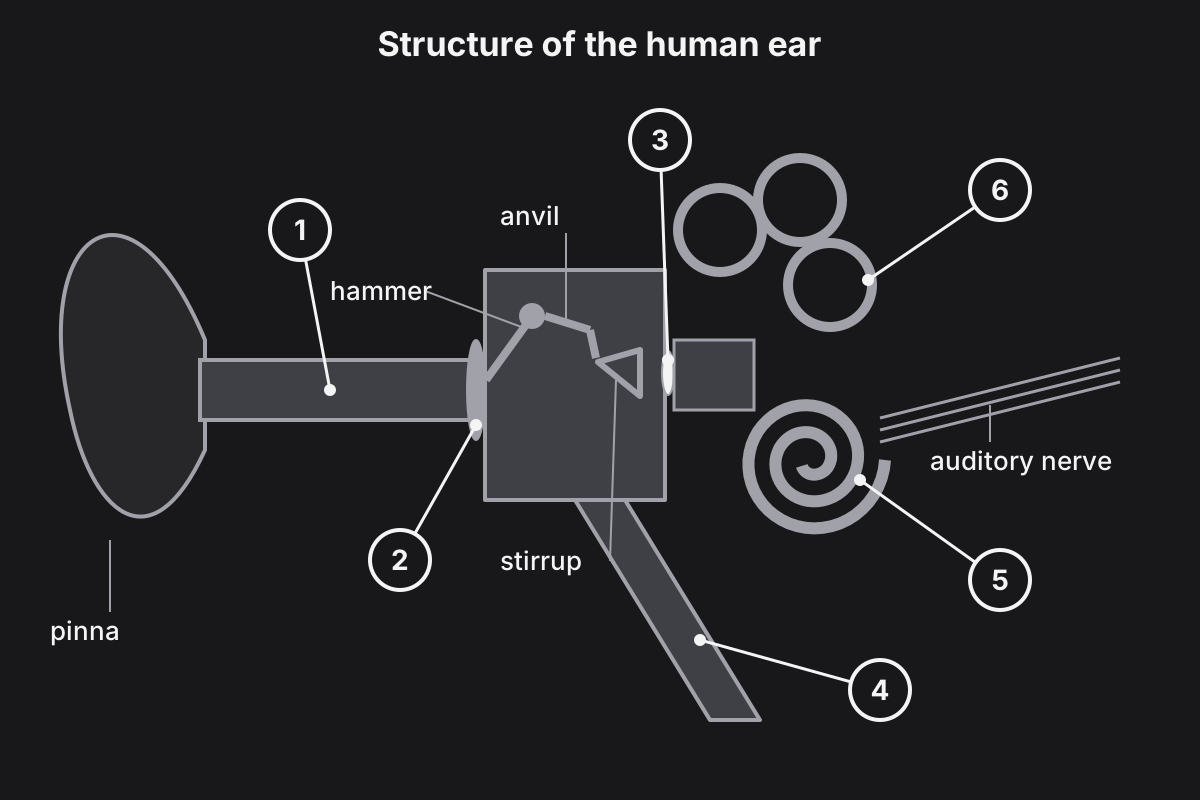
Label the diagram below. Choose NO MORE THAN TWO WORDS from the passage for each answer.
NO MORE THAN TWO WORDS
1 (1) ________ about 2.5 cm long 2 (2) ________ attached to the hammer 3 (3) ________ where the stirrup's base fits 4 (4) ________ leading to the back of the throat 5 (5) ________, which sorts sounds by frequency 6 (6) ________ that help with balance
Answers and explanations
Open one at a time to check as you go, or the key to mark them all.
Answer key: Questions 1–6Show
- 1ear canal
- 2eardrum
- 3oval window
- 4Eustachian tube
- 5cochlea
- 6semicircular canals
11 ________Answer
Answer: ear canal (also accepted: canal)
Paragraph B: 'the ear canal, a tube about two and a half centimetres long'. 'Pinna' is the outer part, already printed.
22 ________Answer
Answer: eardrum (also accepted: the eardrum)
Paragraph C: 'The first, the hammer, is attached to the eardrum'. 'Membrane' describes it but is not its name, and the label point is the drum itself.
33 ________Answer
Answer: oval window
Paragraph C: 'The base of the stirrup fits into a small opening in the bone called the oval window'.
44 ________Answer
Answer: Eustachian tube
Paragraph D: 'the Eustachian tube, connects the middle ear to the back of the throat'.
55 ________Answer
Answer: cochlea (also accepted: the cochlea)
Paragraph E: 'the cochlea sorts complex sounds into their component frequencies'. The 'basilar membrane' runs inside it; the label points to the whole coiled tube.
66 ________Answer
Answer: semicircular canals
Paragraph F: 'three fluid-filled semicircular canals, which ... help us keep our balance'. They are 'not involved in hearing', which is the tempting confusion.
The rest of this passage
Other question types on the same text, like the paper.
More Diagram Label Completion practice
Common questions
Are these real IELTS Reading questions?
No. They're original practice questions written in the official IELTS format and numbering, with answers and explanations. Real test questions aren't published.
How should I use the answers?
Answer every question first, then check. For each one you got wrong, read the explanation and find the line in the passage that gives the answer: that's where the trap or paraphrase is.
Does spelling count?
Yes. In IELTS Reading a misspelt word is marked wrong, and so is an answer over the word limit in the instructions. British and American spellings are both accepted.
Answer it in the app
See right and wrong at once with the reason for each. Free to start, nothing to install.