IELTS Reading · Reading Passage 1
Roman hypocausts: label the diagram
Diagram Label Completion practice, questions 7–11, with the full passage and every answer explained. Try the questions first; the answers are folded away below.
- Questions
- 7–11
- Passage
- 687 words
- Level
- Harder
- Part
- 2 of 2 on this passage
Heating the Roman Bath: The Hypocaust
AThe public baths of ancient Rome were far more than places to wash. They were social centres where citizens of almost every class met to exercise, talk, do business and relax, and the largest, such as the Baths of Caracalla in Rome, could accommodate well over a thousand bathers at a time. A visit typically involved moving through a sequence of rooms at different temperatures, from the cold room, the frigidarium, through the warm tepidarium to the hot room, the caldarium. Keeping these rooms at the right temperature depended on an ingenious heating system known as the hypocaust.
BThe word comes from Greek and means, roughly, 'heat from below'. According to the Roman writer Pliny the Elder, the system was popularised early in the first century BC by Sergius Orata, a businessman better known for farming oysters, although simpler forms of underfloor heating had existed before him. By the time of the empire, hypocausts were standard in public baths throughout the Roman world, from North Africa to Britain, and wealthy families also installed them in their villas, particularly in the colder northern provinces.
CThe heart of the system was the furnace, or praefurnium, a fire chamber built against an outside wall of the building and fed with wood or charcoal by slaves. Its position was carefully chosen: the hottest room, the caldarium, was placed directly next to it, while the warm and cold rooms lay progressively further away. Hot gases from the fire passed through an arched opening into the space beneath the floor, and as they moved away from the furnace they gradually lost heat, so a single fire could warm a whole series of rooms to different temperatures.
DThe floor itself was raised on hundreds of small pillars called pilae, usually built from square clay tiles stacked one on top of another to a height of around sixty centimetres. On top of the pillars rested large tiles, which supported a thick layer of concrete and, finally, the decorated floor surface on which bathers walked, often a mosaic. The concrete absorbed heat slowly and released it steadily, so that the temperature of the room remained even. The architect Vitruvius recommended that the ground beneath the pillars should slope gently towards the furnace, so that the flames would circulate more easily under the floor.
EHeating the floor alone was not enough for the hottest rooms. To raise the temperature further, builders lined the walls with box-shaped hollow tiles called tubuli, placed end to end to form vertical channels. Hot gases rose from beneath the floor through these flues and escaped through vents near the roof, warming the walls as they went. This had a second, practical benefit: by drawing the gases upwards, the flues created a steady flow of air through the whole system, which helped the furnace to burn efficiently. Without them, the smoke tended to collect under the floor and the fire would struggle.
FThe results could be impressive. Floor temperatures in a caldarium may have reached fifty degrees or more, hot enough that bathers wore sandals with thick wooden soles to protect their feet, and the air temperature in the hottest rooms is likely to have been comparable to that in a modern sauna. Archaeologist Dr Paolo Ventura, who has reconstructed a small hypocaust at an experimental site, found that it took about two days of continuous firing to bring the floor up to working temperature from cold, which suggests that the furnaces of public baths were rarely allowed to go out.
GThis constant demand for heat came at a cost. Ventura estimates that a medium-sized public bath may have burned several tonnes of wood every day, and some historians have suggested that the need for fuel contributed to the loss of woodland around large cities. The evidence for this is still debated. What is clear is that the hypocaust was a highly effective technology, and that after the decline of the Roman Empire, nothing comparable was widely used in Europe for well over a thousand years, until central heating began to spread in the nineteenth century.
Questions 7–11
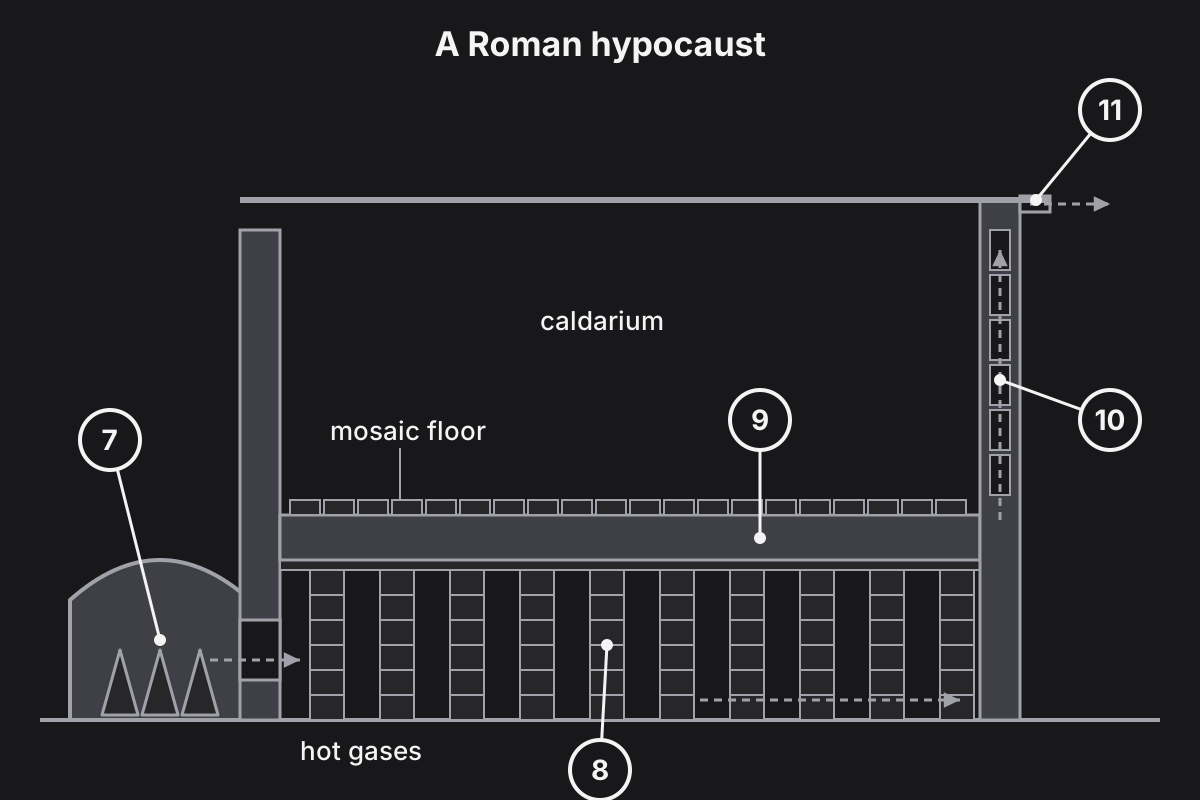
Label the diagram below. Choose ONE WORD ONLY from the passage for each answer.
ONE WORD ONLY
7 (7) ________ fed with wood or charcoal 8 pillars of stacked tiles, or (8) ________ 9 thick layer of (9) ________ that stores heat 10 hollow wall tiles, or (10) ________ 11 (11) ________ near the roof
Answers and explanations
Open one at a time to check as you go, or the key to mark them all.
Answer key: Questions 7–11Show
- 7furnace
- 8pilae
- 9concrete
- 10tubuli
- 11vents
77 ________Answer
Answer: furnace (also accepted: praefurnium)
Paragraph C: 'the furnace, or praefurnium, a fire chamber ... fed with wood or charcoal'. Either name is one word.
88 pillars of stacked tiles, or ________Answer
Answer: pilae
Paragraph D: 'small pillars called pilae, usually built from square clay tiles stacked one on top of another'.
99 thick layer of ________Answer
Answer: concrete
Paragraph D: 'a thick layer of concrete', which 'absorbed heat slowly and released it steadily'. 'Mosaic' is the surface above it, printed on the diagram.
1010 hollow wall tiles, or ________Answer
Answer: tubuli
Paragraph E: 'box-shaped hollow tiles called tubuli'. 'Flues' is the passage's general word for the channels they form; the tiles' name is 'tubuli'.
1111 ________Answer
Answer: vents
Paragraph E: gases 'escaped through vents near the roof'.
The rest of this passage
Other question types on the same text, like the paper.
More Diagram Label Completion practice
Common questions
Are these real IELTS Reading questions?
No. They're original practice questions written in the official IELTS format and numbering, with answers and explanations. Real test questions aren't published.
How should I use the answers?
Answer every question first, then check. For each one you got wrong, read the explanation and find the line in the passage that gives the answer: that's where the trap or paraphrase is.
Does spelling count?
Yes. In IELTS Reading a misspelt word is marked wrong, and so is an answer over the word limit in the instructions. British and American spellings are both accepted.
Answer it in the app
See right and wrong at once with the reason for each. Free to start, nothing to install.