IELTS Reading · Reading Passage 1
The Archimedes screw: label the diagram
Diagram Label Completion practice, questions 7–12, with the full passage and every answer explained. Try the questions first; the answers are folded away below.
- Questions
- 7–12
- Passage
- 720 words
- Level
- Harder
- Part
- 2 of 2 on this passage
The Archimedes Screw: An Ancient Machine Reinvented
AFew machines have had a working life as long as the Archimedes screw. The device, a large helix turning inside a sloping tube, has been used to lift water for well over two thousand years, and versions of it are still being installed today, in sewage works, in land drainage schemes and, most recently, in small hydroelectric plants. Its name links it with the Greek mathematician Archimedes of Syracuse, who lived in the third century BC and is said to have encountered such a device in Egypt. Some historians, however, believe that similar machines may have been used centuries earlier to water the famous gardens of Babylon, and the question of its true origin remains open.
BIn its simplest form, the screw consists of a central shaft around which one or more blades are wound in a continuous spiral, like the thread of a giant bolt. Early versions were made of wood, with the blades formed from thin strips glued and nailed together, and the whole assembly was enclosed in a watertight cylinder of wooden planks bound with iron hoops and sealed with pitch. In many ancient screws, the blades were fixed to the cylinder, so that the cylinder and blades turned together as a single unit.
CThe screw is set at an angle, with its lower end submerged in the water to be raised. When it is turned, each section of the spiral scoops up a little water at the intake and traps it in a pocket formed between the blade and the cylinder wall. As the screw rotates, these pockets move steadily up the tube, and the water is finally released at the outlet at the upper end. Crucially, the water is never actually lifted by the blade in the way a bucket lifts it; rather, it slides continually downwards within each pocket while the pocket itself is carried upwards.
DThe angle of the screw is a compromise. A steep screw raises water to a greater height for a given length, but each pocket holds less water, so the volume delivered falls. A shallow screw moves much more water but cannot lift it very far. In practice, most modern screws are set between about twenty-two and thirty-five degrees from the horizontal, and the Roman engineer Vitruvius, writing in the first century BC, gave instructions that correspond to an angle of around thirty-seven degrees. Ancient screws were usually turned by people treading on the outside of the cylinder, or by a crank handle at the upper end, and one person could typically raise water by only a few metres.
EThe basic design hardly changed for many centuries, but the materials did. From the nineteenth century, steel screws driven by steam engines and later by electric motors were used to drain low-lying land, particularly in the Netherlands, where they could move enormous quantities of water. In modern pumping stations the cylinder is often replaced by a fixed concrete trough, closely shaped to the screw, in which only the shaft and blades rotate. A small gap between the blades and the trough allows the screw to turn freely, although some water leaks back through it.
FThe most recent application reverses the machine's original purpose. Instead of using energy to lift water, an Archimedes screw turbine allows water to flow down through the screw, which turns a generator at its upper end. Such turbines are particularly suited to rivers with a low head, that is, a small drop in height, where conventional turbines would be uneconomic. Since the first installations in Germany in the 1990s, hundreds have been built across Europe, many on the sites of old watermills, where weirs already exist.
GOne of their chief advantages is that they appear to be relatively safe for fish. Because the screw turns slowly and the pockets of water are large, most fish pass through unharmed, whereas the fast-spinning blades of a conventional turbine can injure or kill them. Biologist Dr Clara Mendes, who monitored eels passing through screws on two English rivers, found that over ninety-eight per cent survived, although she cautions that larger fish may be struck by the leading edge of the blade as they enter. Her team now recommends fitting the edge with a rubber bumper, a simple change that further reduces injuries.
Questions 7–12
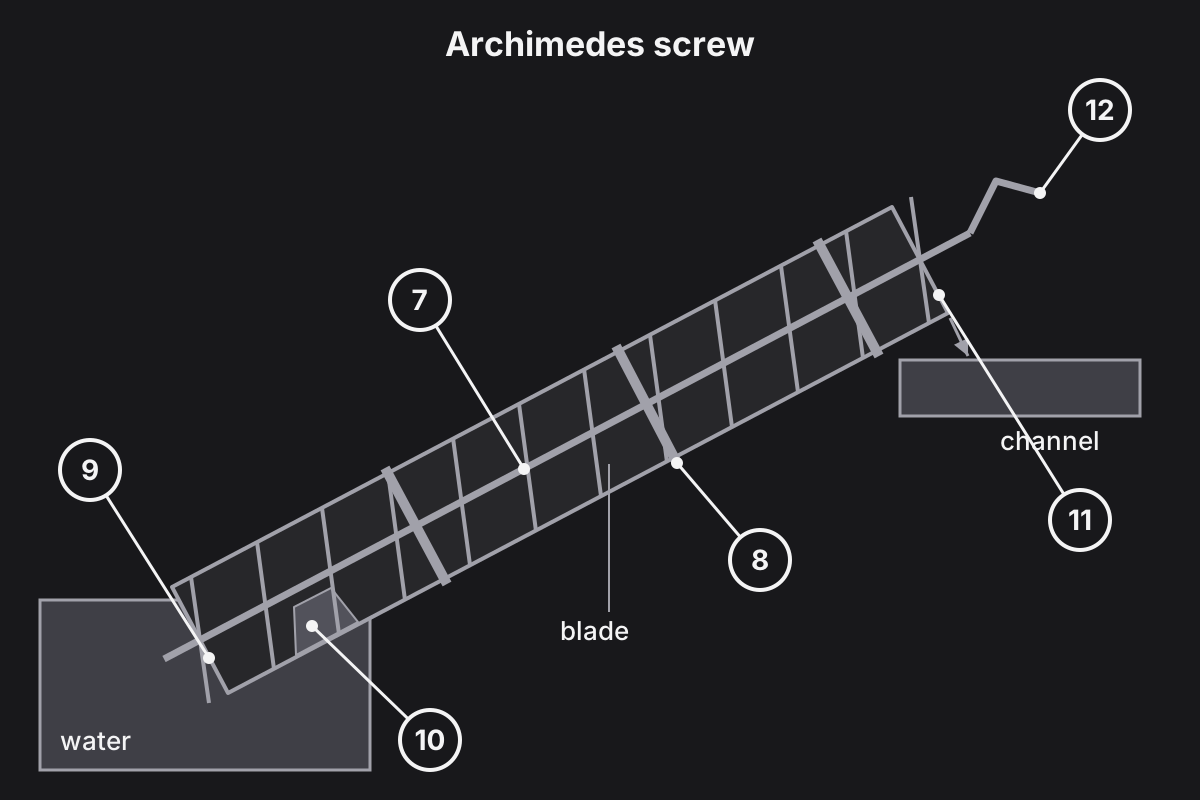
Label the diagram below. Choose NO MORE THAN TWO WORDS from the passage for each answer.
NO MORE THAN TWO WORDS
7 central (7) ________ carrying the spiral blades 8 (8) ________ holding the wooden planks together 9 (9) ________ where water is first scooped up 10 water trapped in a (10) ________ between blade and wall 11 (11) ________ at the upper end 12 (12) ________ for turning the screw by hand
Answers and explanations
Open one at a time to check as you go, or the key to mark them all.
Answer key: Questions 7–12Show
- 7shaft
- 8iron hoops
- 9intake
- 10pocket
- 11outlet
- 12crank handle
77 central ________Answer
Answer: shaft
Paragraph B: 'a central shaft around which one or more blades are wound'. 'Blade' is printed on the diagram.
88 ________Answer
Answer: iron hoops (also accepted: hoops)
Paragraph B: 'a watertight cylinder of wooden planks bound with iron hoops'. 'Pitch' seals the planks; it does not hold them together.
99 ________Answer
Answer: intake (also accepted: the intake)
Paragraph C: each section of the spiral 'scoops up a little water at the intake'.
1010 water trapped in a ________Answer
Answer: pocket
Paragraph C: water is trapped 'in a pocket formed between the blade and the cylinder wall'. The gap ('a ___') needs a singular noun.
1111 ________Answer
Answer: outlet (also accepted: the outlet)
Paragraph C: 'the water is finally released at the outlet at the upper end'.
1212 ________Answer
Answer: crank handle (also accepted: crank)
Paragraph D: screws were turned 'by people treading on the outside of the cylinder, or by a crank handle at the upper end'.
The rest of this passage
Other question types on the same text, like the paper.
More Diagram Label Completion practice
Common questions
Are these real IELTS Reading questions?
No. They're original practice questions written in the official IELTS format and numbering, with answers and explanations. Real test questions aren't published.
How should I use the answers?
Answer every question first, then check. For each one you got wrong, read the explanation and find the line in the passage that gives the answer: that's where the trap or paraphrase is.
Does spelling count?
Yes. In IELTS Reading a misspelt word is marked wrong, and so is an answer over the word limit in the instructions. British and American spellings are both accepted.
Answer it in the app
See right and wrong at once with the reason for each. Free to start, nothing to install.