IELTS Reading · Reading Passage 1
Limestone caves: label the diagram
Diagram Label Completion practice, questions 7–12, with the full passage and every answer explained. Try the questions first; the answers are folded away below.
- Questions
- 7–12
- Passage
- 698 words
- Level
- Harder
- Part
- 2 of 2 on this passage
How Limestone Caves Form
ABeneath many limestone landscapes lies a hidden world of passages, chambers and underground rivers. Caves of this kind are found on every continent except Antarctica, and some are enormous: the Mammoth Cave system in Kentucky has more than 680 kilometres of surveyed passages, making it the longest known cave system in the world, and Son Doong in Vietnam contains a single passage large enough to hold a city block. Yet these spaces were carved not by violent forces but by one of the gentlest processes in nature: the slow dissolving of rock by water.
BThe process begins in the sky. As rain falls, it absorbs a small amount of carbon dioxide from the air, and much more as it soaks through the soil, where decaying plants and soil organisms release the gas in large quantities. The result is a weak solution of carbonic acid. Limestone is made mainly of calcium carbonate, which reacts with this acid and gradually dissolves, so water seeping into the rock slowly enlarges any openings it finds.
CThose openings are crucial. Limestone usually forms in horizontal layers on the sea floor, and when it is later raised and exposed, it is cut by two kinds of weakness: bedding planes, which are the boundaries between the layers, and joints, which are vertical cracks running through them. Water moves down the joints and along the bedding planes, widening them over thousands of years. At the surface, a joint that has been widened in this way may become a swallow hole, a deep shaft into which a stream disappears underground.
DMost cave passages develop at or just below the water table, the level below which the rock is saturated with water. Here, slow-moving water dissolves the rock on all sides, forming tubes that are often roughly circular in cross-section. If the water table later falls, perhaps because a nearby river has cut its valley deeper, these passages are left filled with air, and the stream that once filled them may cut a narrow trench in the floor, or abandon the passage entirely for a new route at a lower level. Many large cave systems therefore consist of several levels of passages, one above the other, each recording an earlier position of the water table.
EOnce a passage is filled with air, a different process begins. Water dripping from the ceiling has dissolved calcium carbonate on its way through the rock above. When it reaches the open air of the cave, it loses some of its carbon dioxide, and as a result it can no longer hold all of the dissolved mineral. A tiny ring of calcite is deposited around the edge of each drop, and over time this grows into a thin, hollow tube known as a soda straw. If the tube becomes blocked, water begins to flow down the outside, and the formation thickens into a stalactite, hanging from the roof like an icicle.
FWhere the drops fall to the floor, they deposit more calcite, building up a stalagmite, which is usually broader and more rounded at the top than the stalactite above it. Given enough time, the two may meet and join to form a column. Water flowing in a thin sheet over walls or floors leaves layered deposits known as flowstone, and where it trickles along a sloping ceiling, it can produce thin, wavy sheets called curtains. Growth is extremely slow, often only a fraction of a millimetre a year, and a large stalagmite may be tens of thousands of years old.
GBecause stalagmites grow in layers, like tree rings, they have become valuable archives of past climate. Geochemist Dr Isabel Torres explains that the chemistry of each layer reflects the temperature and rainfall at the time it formed, and that the layers can be dated with great precision. Her team's analysis of stalagmites from caves in southern Spain, she says, has revealed droughts lasting several decades that are not recorded in any written source. Such records, however, depend on caves remaining undisturbed; touching formations leaves oils from the skin that can stop their growth, which is why many show caves now keep visitors on fixed paths.
Questions 7–12
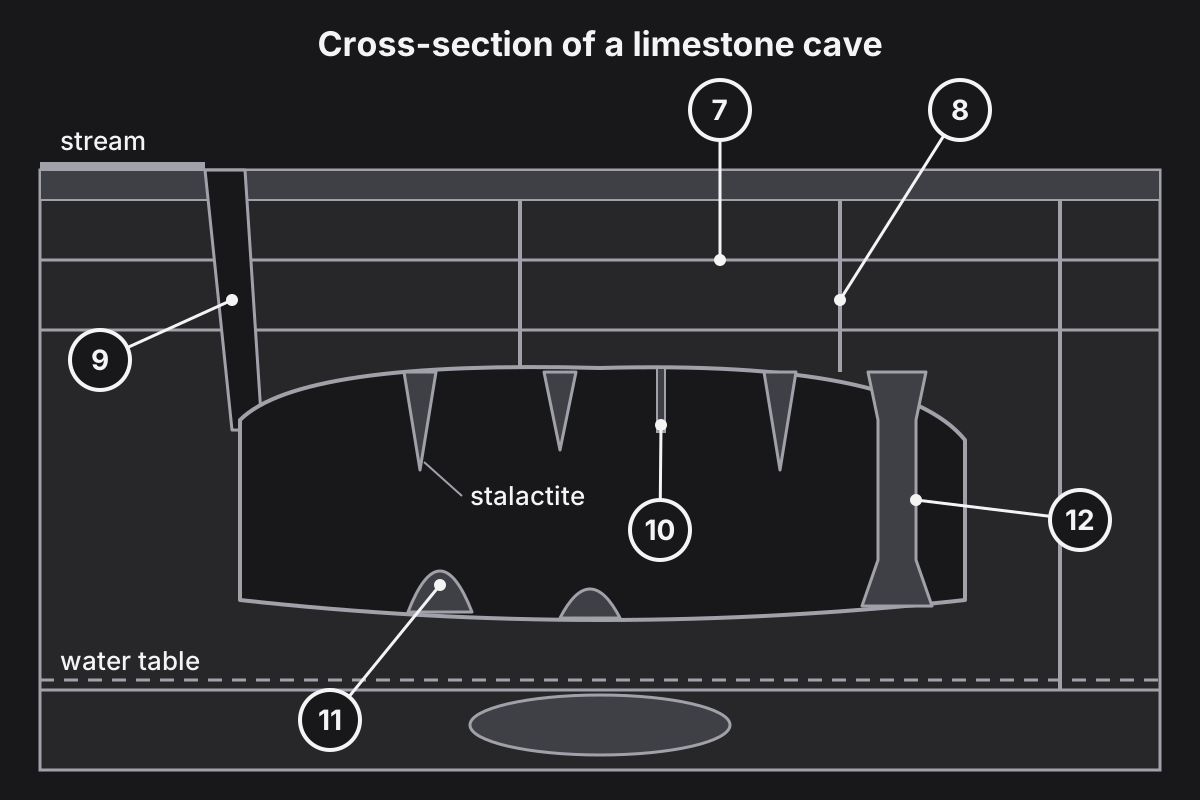
Label the diagram below. Choose NO MORE THAN TWO WORDS from the passage for each answer.
NO MORE THAN TWO WORDS
7 (7) ________ between rock layers 8 vertical (8) ________ widened by water 9 (9) ________ taking the stream underground 10 thin, hollow (10) ________ 11 rounded (11) ________ on the floor 12 (12) ________ where the two formations meet
Answers and explanations
Open one at a time to check as you go, or the key to mark them all.
Answer key: Questions 7–12Show
- 7bedding plane
- 8joint
- 9swallow hole
- 10soda straw
- 11stalagmite
- 12column
77 ________Answer
Answer: bedding plane (also accepted: bedding planes)
Paragraph C: 'bedding planes, which are the boundaries between the layers'.
88 vertical ________Answer
Answer: joint (also accepted: joints, crack, cracks)
Paragraph C: 'joints, which are vertical cracks running through them'. 'Joint' is the geological name; 'crack' also fits after 'vertical'.
99 ________Answer
Answer: swallow hole
Paragraph C: 'a swallow hole, a deep shaft into which a stream disappears underground'. 'Shaft' describes it; the label wants the name.
1010 thin, hollow ________Answer
Answer: soda straw
Paragraph E: 'a thin, hollow tube known as a soda straw'. 'Tube' would repeat the description; the name is 'soda straw'.
1111 rounded ________Answer
Answer: stalagmite
Paragraph F: 'a stalagmite, which is usually broader and more rounded at the top'. 'Stalactite' (printed) hangs from the roof.
1212 ________Answer
Answer: column (also accepted: a column)
Paragraph F: 'the two may meet and join to form a column'. 'Flowstone' forms in sheets on walls and floors.
The rest of this passage
Other question types on the same text, like the paper.
More Diagram Label Completion practice
Common questions
Are these real IELTS Reading questions?
No. They're original practice questions written in the official IELTS format and numbering, with answers and explanations. Real test questions aren't published.
How should I use the answers?
Answer every question first, then check. For each one you got wrong, read the explanation and find the line in the passage that gives the answer: that's where the trap or paraphrase is.
Does spelling count?
Yes. In IELTS Reading a misspelt word is marked wrong, and so is an answer over the word limit in the instructions. British and American spellings are both accepted.
Answer it in the app
See right and wrong at once with the reason for each. Free to start, nothing to install.