IELTS Reading · Reading Passage 1
The hydraulic ram pump: label the diagram
Diagram Label Completion practice, questions 1–6, with the full passage and every answer explained. Try the questions first; the answers are folded away below.
- Questions
- 1–6
- Passage
- 689 words
- Level
- Easier
- Part
- 1 of 2 on this passage
The Pump That Needs No Power
AIn hilly country, it is common to find a spring or stream running in a valley while the farm or village that needs its water stands on higher ground above. Moving water uphill normally requires a pump driven by electricity, fuel or muscle. Yet for more than two centuries, a device has existed that can raise water to a height many times greater than the fall of the stream that drives it, using no external energy at all. It is called the hydraulic ram, and its only moving parts are two valves.
BThe ram was developed in stages. In 1772 the English clockmaker John Whitehurst built a device in which a tap at the bottom of a long pipe had to be opened and closed by hand. The first fully automatic version was patented in 1796 by the Frenchman Joseph Michel Montgolfier, who is better remembered, with his brother, for pioneering the hot-air balloon. Montgolfier's design, with improvements, was manufactured in large numbers during the nineteenth century, and rams supplied water to country houses, farms and even small towns across Europe and North America.
CA ram system begins with a source of water above the pump, such as a small dam or supply tank on a stream. From here, water runs down through the drive pipe, a long, rigid pipe that must be strong enough to withstand repeated shocks; flexible hose will not work, because it absorbs the energy that the ram depends on. At the lower end of the drive pipe sits the ram itself, a compact metal body containing the two valves.
DThe first of these is the waste valve, which at the start of each cycle is open. Water accelerates down the drive pipe and pours out through it, until the flow becomes fast enough to slam the valve shut. The sudden stopping of a moving column of water produces a sharp rise in pressure, an effect known to plumbers as water hammer and familiar from the banging that sometimes follows the closing of a tap. In a ram, this pressure surge forces open the second valve, the delivery valve, and pushes a small quantity of water through it into the air chamber.
EThe air chamber is a closed vessel in which a cushion of trapped air is compressed by the incoming water. As the pressure surge passes, the delivery valve closes again, preventing water from flowing back, and the compressed air pushes the water steadily out of the chamber and up the delivery pipe to the storage tank at the top of the hill. In this way, the jerky pulses of the ram are converted into a smooth flow. Over time, some of the air dissolves into the water, so many rams include a tiny opening called a snifter valve, which lets in a small amount of air on each cycle to keep the cushion topped up.
FMeanwhile, with the pressure in the drive pipe reduced, the waste valve falls open under its own weight, water begins to accelerate down the drive pipe once more, and the cycle repeats, typically between thirty and a hundred times a minute. Most of the water that enters the system is lost through the waste valve and returns to the stream. As a rough rule, a ram can lift around a twentieth of the water passing through it to a height ten times the fall from the source; the higher the water must go, the smaller the share that is delivered.
GFor much of the twentieth century, rams were replaced by electric and diesel pumps, and many were left to rust. In recent decades, however, they have attracted renewed interest, particularly in rural areas of developing countries, where electricity is unreliable and fuel expensive. Engineer Dr Kofi Mensah, who has installed rams in several villages in Ghana, points out that a well-made ram can run day and night for decades with almost no maintenance beyond the occasional replacement of a valve rubber. Their main limitation, he admits, is that they need a steady supply of falling water, which not every community has.
Questions 1–6
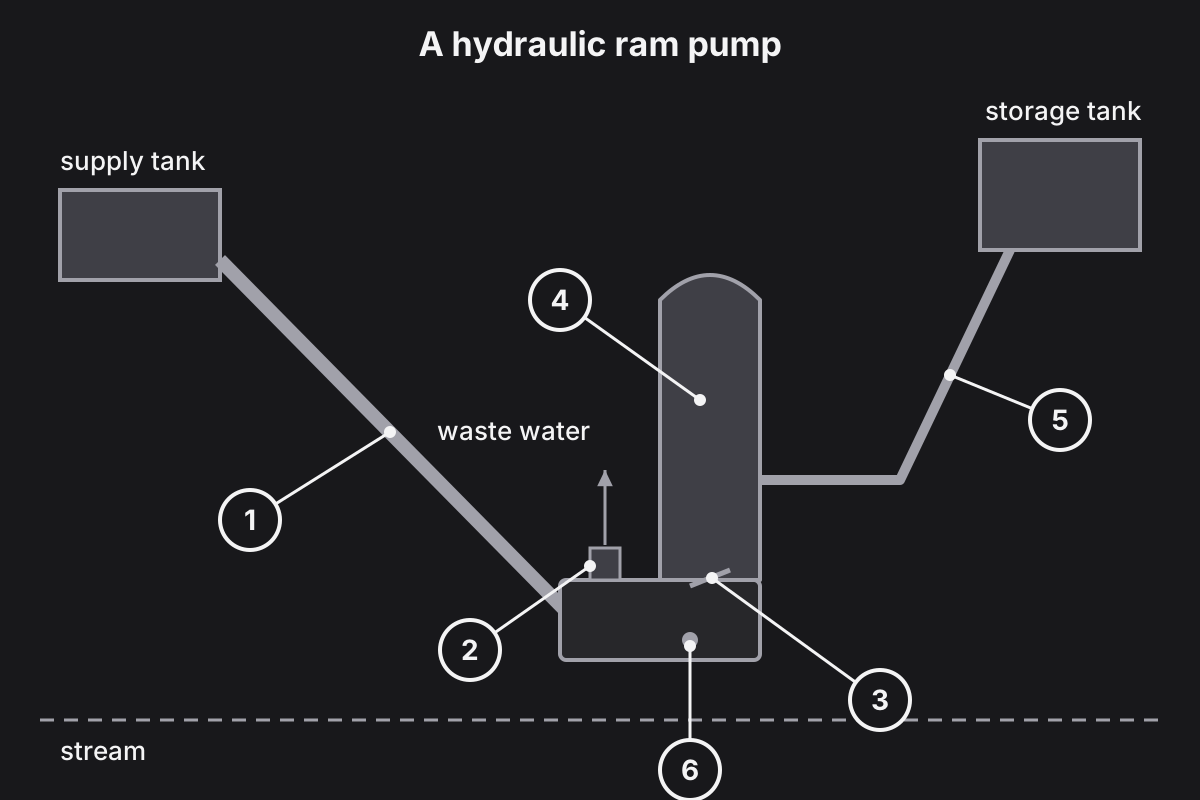
Label the diagram below. Choose NO MORE THAN TWO WORDS from the passage for each answer.
NO MORE THAN TWO WORDS
1 long, rigid (1) ________ 2 (2) ________ that slams shut 3 (3) ________ forced open by the pressure surge 4 (4) ________ with a cushion of compressed air 5 (5) ________ leading up to the storage tank 6 (6) ________ letting in air on each cycle
Answers and explanations
Open one at a time to check as you go, or the key to mark them all.
Answer key: Questions 1–6Show
- 1drive pipe
- 2waste valve
- 3delivery valve
- 4air chamber
- 5delivery pipe
- 6snifter valve
11 long, rigid ________Answer
Answer: drive pipe
Paragraph C: 'the drive pipe, a long, rigid pipe that must be strong enough to withstand repeated shocks'.
22 ________Answer
Answer: waste valve
Paragraph D: water flows out through 'the waste valve' until it is fast enough 'to slam the valve shut'.
33 ________Answer
Answer: delivery valve
Paragraph D: 'this pressure surge forces open the second valve, the delivery valve'. Do not confuse it with the 'snifter valve', which admits air.
44 ________Answer
Answer: air chamber
Paragraph E: 'The air chamber is a closed vessel in which a cushion of trapped air is compressed'.
55 ________Answer
Answer: delivery pipe
Paragraph E: water is pushed 'up the delivery pipe to the storage tank'. The 'drive pipe' brings water down to the ram.
66 ________Answer
Answer: snifter valve
Paragraph E: 'a tiny opening called a snifter valve, which lets in a small amount of air on each cycle'.
The rest of this passage
Other question types on the same text, like the paper.
More Diagram Label Completion practice
Common questions
Are these real IELTS Reading questions?
No. They're original practice questions written in the official IELTS format and numbering, with answers and explanations. Real test questions aren't published.
How should I use the answers?
Answer every question first, then check. For each one you got wrong, read the explanation and find the line in the passage that gives the answer: that's where the trap or paraphrase is.
Does spelling count?
Yes. In IELTS Reading a misspelt word is marked wrong, and so is an answer over the word limit in the instructions. British and American spellings are both accepted.
Answer it in the app
See right and wrong at once with the reason for each. Free to start, nothing to install.