IELTS Reading · Reading Passage 1
Tide mills: label the diagram
Diagram Label Completion practice, questions 7–12, with the full passage and every answer explained. Try the questions first; the answers are folded away below.
- Questions
- 7–12
- Passage
- 696 words
- Level
- Harder
- Part
- 2 of 2 on this passage
Harnessing the Tides
ALong before engineers began to talk of tidal power stations, millers on the coasts of Europe were putting the sea to work. A tide mill uses the twice-daily rise and fall of the tide to turn a waterwheel, and from the early Middle Ages until the nineteenth century such mills ground grain in estuaries from Portugal to the Netherlands and along the eastern seaboard of North America. Hundreds were built in Britain and France alone. Today only a few survive in working order, but historians and engineers are taking a renewed interest in them, partly as a model for small-scale renewable energy.
BThe basic requirement was a sheltered inlet where the difference between high and low tide was large, ideally several metres. Across the mouth of a creek, or along one side of it, the builders raised an earth embankment, often faced with stone, which enclosed an area of tidal water known as the millpond. Some millponds covered more than ten hectares. The mill building itself usually stood on the embankment, so that the water stored behind it could be directed through the wheel and out to the estuary on the other side.
CFilling the pond required no effort from the miller. Set into the embankment were the sea gates, large wooden flaps hinged at the top. As the tide rose, the pressure of the incoming water pushed them open and the pond filled. When the tide turned and began to fall, the weight of the water inside the pond swung them shut again, trapping a great volume of water at the level of high tide. The mill could not yet operate, however, because the water outside was still almost as high as that within.
DThe miller had to wait until the tide had fallen far enough to create a useful difference in level, usually two or three hours after high water. He then raised the sluice, a vertical wooden gate operated by a rack and pinion, which released water from the pond into a channel called the mill race. The water rushed along the race and struck the waterwheel, which in most tide mills was an undershot wheel, driven by water passing beneath it, or a breastshot wheel, where the water struck it at about the height of the axle.
EInside the building, the slowly turning wheel shaft drove a large gear known as the pit wheel, which turned a smaller gear to increase the speed of rotation. This in turn drove the millstones on the floor above. Grain was poured into a wooden hopper above the stones and trickled through a hole in the centre of the upper stone, the runner, which revolved just above a fixed lower stone. The flour was gradually forced outwards between them and collected in a wooden case around the stones. Having passed the wheel, the spent water ran away through the tailrace back into the estuary.
FThe working day of a tide miller was ruled by the moon rather than the sun. Because the tides arrive about fifty minutes later each day, the miller's hours shifted constantly, and he frequently worked through the night. A mill could typically grind for between four and six hours on each tide before the falling level in the pond and the returning tide outside brought it to a standstill. Spring tides, which occur twice a month near the new and full moon, gave the best working conditions; during neap tides, when the range was smaller, output fell sharply.
GThe decline of tide mills began with the steam engine, which allowed large mills to grind continuously in towns, close to their customers. Many coastal mills were abandoned, and their ponds silted up or were drained for farmland. Engineer Rachel Penhallow, who has studied the remains of more than sixty sites in south-west England, argues that their builders understood something modern designers sometimes forget: a tidal scheme succeeds only if it works with the natural rhythm of the estuary. Her calculations suggest that a restored millpond could power a small turbine for a village, although she admits that the cost of rebuilding the embankments would be considerable.
Questions 7–12
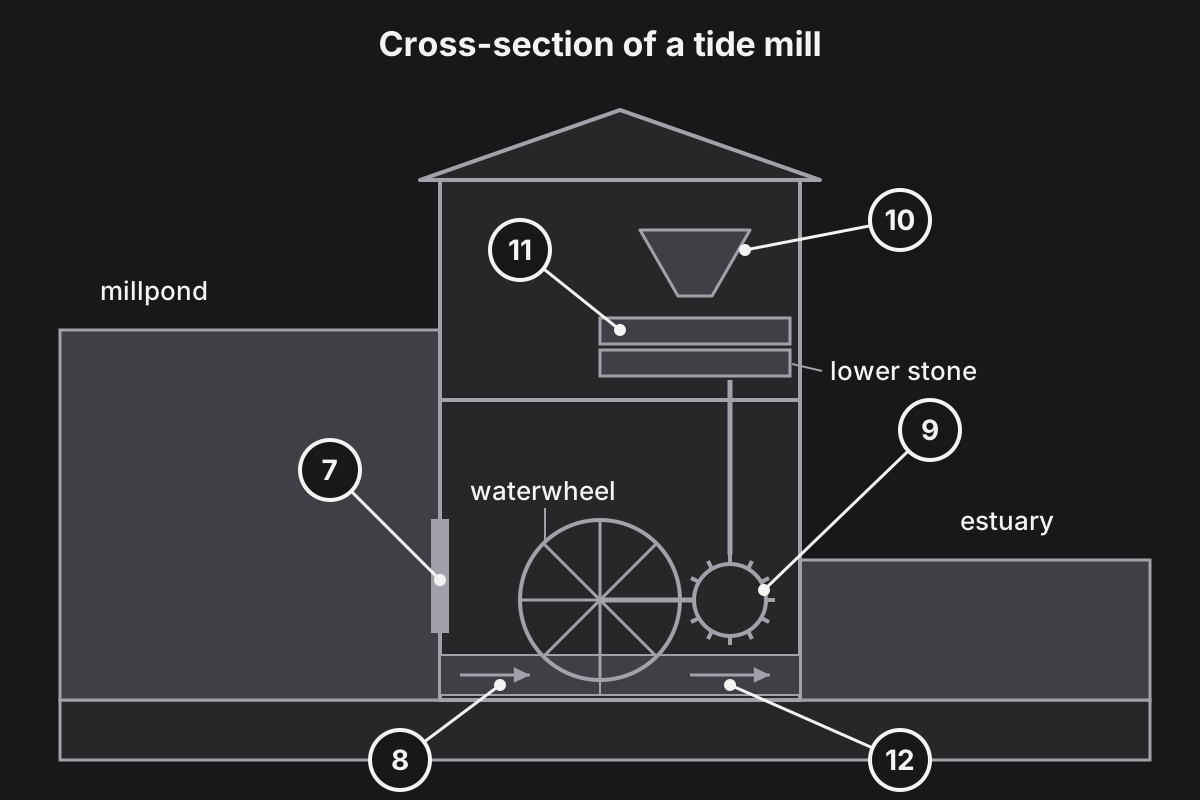
Label the diagram below. Choose NO MORE THAN TWO WORDS from the passage for each answer.
NO MORE THAN TWO WORDS
7 (7) ________ raised by a rack and pinion 8 (8) ________ carrying water to the wheel 9 (9) ________ on the wheel shaft 10 wooden (10) ________ for grain 11 upper stone, or (11) ________ 12 (12) ________ returning water to the estuary
Answers and explanations
Open one at a time to check as you go, or the key to mark them all.
Answer key: Questions 7–12Show
- 7sluice
- 8mill race
- 9pit wheel
- 10hopper
- 11runner
- 12tailrace
77 ________Answer
Answer: sluice (also accepted: the sluice)
Paragraph D: 'the sluice, a vertical wooden gate operated by a rack and pinion'. The 'sea gates' (Paragraph C) let water into the pond; they are not part of the mill building.
88 ________Answer
Answer: mill race (also accepted: race)
Paragraph D: water was released 'into a channel called the mill race'. The 'tailrace' carries water away from the wheel.
99 ________Answer
Answer: pit wheel
Paragraph E: 'the slowly turning wheel shaft drove a large gear known as the pit wheel'.
1010 wooden ________Answer
Answer: hopper
Paragraph E: 'Grain was poured into a wooden hopper above the stones'. 'Wooden' is printed.
1111 upper stone, or ________Answer
Answer: runner (also accepted: the runner)
Paragraph E: 'the upper stone, the runner, which revolved just above a fixed lower stone'. The lower stone is printed on the diagram.
1212 ________Answer
Answer: tailrace (also accepted: the tailrace)
Paragraph E: 'the spent water ran away through the tailrace back into the estuary'. Do not confuse it with the 'mill race', which brings water to the wheel.
The rest of this passage
Other question types on the same text, like the paper.
More Diagram Label Completion practice
Common questions
Are these real IELTS Reading questions?
No. They're original practice questions written in the official IELTS format and numbering, with answers and explanations. Real test questions aren't published.
How should I use the answers?
Answer every question first, then check. For each one you got wrong, read the explanation and find the line in the passage that gives the answer: that's where the trap or paraphrase is.
Does spelling count?
Yes. In IELTS Reading a misspelt word is marked wrong, and so is an answer over the word limit in the instructions. British and American spellings are both accepted.
Answer it in the app
See right and wrong at once with the reason for each. Free to start, nothing to install.